Zodiac Mahjong
12 boards · free, no download.
12 boards · free, no download.
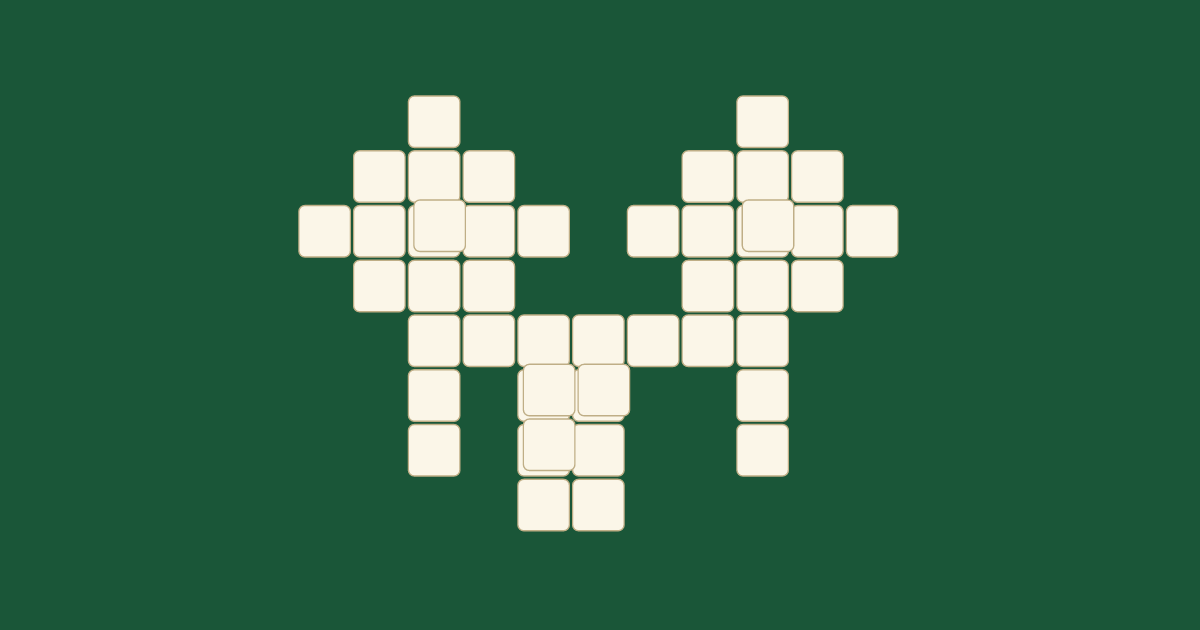
Play Zodiac Mahjong free online — every board loads instantly in your browser, no download, no sign-up. Zodiac Mahjong is the collection of Mahjong Solitaire boards where the tiles are not poured into a generic pyramid or a tidy rhombus but are laid out to draw a picture: each board takes one of the twelve signs of the western zodiac and builds its symbol out of tiles. Aries arrives as the curling horns of the ram, Taurus as the blunt head and horns of the bull, Gemini as the paired figures of the twins, Cancer as the rounded shell of the crab, and so on through Leo, Virgo, Libra, Scorpio, Sagittarius, Capricorn, Aquarius, and Pisces. Every silhouette is designed by hand for that one sign, which means the set is not twelve copies of the same wall in twelve colors. It is twelve genuinely different puzzles that happen to share an astrological theme, so playing through them feels like a tour of the night sky rather than a grind through reskins.
The pull of these boards is part personal and part puzzle. Almost everyone knows their own star sign, and there is a small, real pleasure in finding your sign in the list and sitting down to clear the board that is shaped like it, then coming back to play the signs of the people you know. Underneath that hook is solid Mahjong Solitaire: you still win by removing identical pairs of free tiles until the picture dissolves, and because each sign is a different drawing, each one opens up and comes apart in its own way. A board shaped like the scales of Libra plays nothing like a board shaped like the long curve of Scorpio's tail. This hub gathers all twelve signs in one place, every one of them a complete, hand-checked, fully solvable puzzle, so you can pick by your birthday, by curiosity, or simply by the shape that looks the most fun to take apart.
Mahjong Solitaire is a tile-matching game, not the four-player game of the same name, and its single rule is easy to state: you may remove a pair of identical tiles whenever both of them are free. A tile is free when nothing is stacked on top of it and at least one of its long sides, left or right, is open to empty space. Match a free pair and it disappears, which can uncover or unblock the tiles that were sitting beneath or beside it. Clear every tile and the board is won. None of that changes in the Zodiac collection. What changes is the outline the tiles are arranged into, and in this set that outline is a constellation symbol rather than a geometric block.
Because the board is a picture, the shape does real work in how the puzzle feels. A standard rectangular wall has long straight rows where only the two end tiles are open, so the middle stays locked for ages. A zodiac silhouette is almost never a solid rectangle. It is made of arms, horns, tails, claws, curves, and gaps, and every one of those protruding parts is an exposed edge that hands you a free tile from the very first move. The thin, reaching limbs of a sign tend to be the most open, while any place where the drawing thickens into a body or a knot of tiles is where the resistance hides. Reading a zodiac board is mostly a matter of seeing where the picture sticks out and where it bunches up.
It is worth saying plainly that the astrology here is decoration, not mechanics. The tiles themselves are the ordinary Mahjong faces, the suits of Circles, Bamboo, and Characters together with the Winds, Dragons, Flowers, and Seasons, and the matching rules are the standard ones players already know. The Flowers and Seasons follow the usual friendly convention, where any Flower pairs with any other Flower and any Season pairs with any other Season, so a set always behaves the way it looks like it should. Your star sign does not give you a secret advantage on its own board and a sign you dislike will not deal you a harder game out of spite. The theme chooses the shape; the shape is what you actually play.
The first move on any zodiac board happens before you touch a tile: read the outline. Take a second to see what the picture is, because the symbol tells you where the openings are. The parts of a sign that reach out into empty space, the tips of Aries' horns, the points of Sagittarius' arrow, the splayed legs of Cancer, the dangling hook of Scorpio's stinger, are the most exposed tiles on the board, and they are almost always where you should begin. Starting from the most exposed limb and working back toward the body is the single habit that serves you on all twelve signs, because it peels the drawing inward from its thinnest edges toward its densest core.
Several of the signs are built with a clear line of symmetry, and those reward a particular discipline: clear both halves in step rather than stripping one side bare. Gemini is the obvious case, two mirrored figures standing together, but the balanced scales of Libra, the paired curves of Pisces, and the broad symmetrical head of Taurus all share the same property. On a symmetrical board, a great many pairs are split across the line, with one tile on the left half and its twin on the right, so emptying one side first can leave its leftover tiles with no reachable partner. Treat a symmetrical sign as one connected problem with a shared pace, and let the two halves shrink together. The board both looks and plays better for it.
Past the opening, the work is sequencing. Before you spend a pair, glance at what each of those two tiles is holding down, and prefer the match that frees the most underneath or opens a new stretch of the picture over a match that frees nothing. When you can see all four copies of a tile on the board, take the two that unlock the most and keep the other two in reserve as a safety valve, rather than burning all four early. The places to be careful are exactly the spots where the silhouette thickens, the body of the bull, the coil at the centre of Scorpio, the knot where the twins meet, because those interior tiles release only after the limbs around them have come down. A middle that looks dead almost always means a limb tile is still propping it up, so rescan the outline before you assume you are stuck.
If you genuinely run out of legal moves, the run is not over. Use Shuffle to re-deal the remaining tiles, and that re-deal is always solvable, so the puzzle stays winnable instead of collapsing into a guess the way a careless shuffle would in some older games. Lean on Hint when you want to confirm that a live pair exists rather than to play the board for you, and lean on Undo to back out of a move that closed a door you meant to keep open. On a particular sign that has dealt you into an awkward corner, a Shuffle is often the cleanest way to loosen a stubborn knot. None of these tools are cheating; they are what turn each constellation from a coin flip into a solvable picture, and using them thoughtfully is exactly how a relaxed player gets the most out of the set.
The defining feature of this hub is that it holds twelve distinct layouts, one per sign, and the variety comes from the symbols themselves rather than from color swaps. The fire signs give you bold, pointed shapes: Aries is the ram's curling horns, a board that opens fast from its two horn tips; Leo is the lion, often drawn as the loop and tail of its glyph, with a rounded mane of tiles that thickens toward the centre; and Sagittarius is the archer's arrow, a long diagonal with an arrowhead and flights at the ends that practically beg to be cleared first. These tend to feel brisk and outgoing to take apart, with plenty of exposed points to start on.
The earth and air signs bring different geometries. Taurus is the bull's head, a wide symmetrical form with two horns reaching up and a solid face between them. Virgo is the maiden, a more upright, flowing figure. Capricorn is the sea-goat, a shape that runs from a horned head into a curling tail. Among the air signs, Gemini is the clearest test of symmetry with its two side-by-side twins; Libra is the scales, a balanced board where the two pans hang to either side of a central beam and want to be cleared evenly; and Aquarius is the water-bearer, usually rendered as the two parallel wavy lines of its glyph, a board of flowing horizontal bands. Each of these plays to a different instinct, the balance of Libra against the mirrored halves of Gemini against the long ripples of Aquarius.
The water signs round out the set with curves and tails. Cancer is the crab, a rounded body with legs and claws splaying outward, so the exposed limbs come off first and the shell is the patience phase. Scorpio is the scorpion, dominated by the long sweeping tail that ends in a stinger, a board you naturally unzip from the tip of the tail inward. Pisces is the two fish, drawn as a pair of arcs bound together and swimming in opposite directions, a gently symmetrical shape that comes apart from its outer curves. Twelve signs, three or four of them broadly symmetrical, the rest leaning on points and tails and limbs, and not one of them is the standard rectangular wall. Whichever sign you load, you are getting a purpose-drawn picture to dismantle, and every one of them is a complete, solvable puzzle from the deal.
The zodiac is one of the oldest pictures humanity has drawn. The twelve signs trace back thousands of years to Babylonian sky-watchers who divided the band of sky the sun travels through into twelve parts and named each after a constellation, and the symbols were carried forward through Greek and Roman astronomy into the familiar set we use today. Most of the figures are animals, which is exactly where the word zodiac comes from, a Greek root meaning a circle of little creatures, and that menagerie of ram, bull, crab, lion, scorpion, goat, and fish is what gives this Mahjong collection such a rich spread of shapes to work with. Building each one out of tiles turns an ancient star chart into something you take apart with your hands.
There is a personal warmth to the theme that geometric boards simply cannot offer. A diamond or a pyramid is handsome but anonymous; your star sign is yours. People know their sign, they know the signs of their partner and their children and their friends, and a set of twelve sign-shaped boards invites a kind of play no plain shape does, working through the signs that matter to you and noticing how differently each one behaves. The boards lean into that gently, each sign carrying its own character on the screen, the fire signs sharp and reaching, the water signs curling and soft, so the collection reads like a zodiac wheel you can actually clear one house at a time.
Part of the quiet fun is watching a recognizable picture come undone. Most Mahjong layouts shrink into smaller versions of the same blob, but a zodiac board dissolves a drawing: the horns of the ram shorten, the scorpion's tail retracts toward its body, the twins thin until they vanish. Because the shape means something, the act of clearing it has a small narrative to it that a wall of tiles does not. For a player who comes to Mahjong Solitaire to unwind, there is a particular satisfaction in dismantling a symbol you have seen your whole life, tile by tile, until the sky is clear.
As a category, the zodiac boards land in a friendly-to-moderate band, and the reason is structural. Because every sign is an irregular drawing full of horns, limbs, tails, and gaps rather than a solid block, there are exposed edges all over the outline from the start, so you are rarely starved for an opening move. The shapes that lean on long thin features, the arrow of Sagittarius, the tail of Scorpio, the waves of Aquarius, tend to be the most generous, peeling apart smoothly from their tips. The signs that gather into a denser body, like the head of Taurus or the mane of Leo, ask for a little more patience in the middle, but none of them is a brutal interlocked grid. That makes the set a comfortable home for relaxed and older players who want a thinking game that rewards care without punishing a single tap.
The challenge in this collection is more about reading and pacing than raw density. Symmetrical signs reward the discipline of clearing both halves together, and the trap, when there is one, is the familiar Mahjong mistake of stripping one side or one limb so far ahead of the rest that you strand a tile with no reachable twin. That pitfall is avoided with a little forethought rather than memorization, which keeps the difficulty fair and learnable. Because the twelve boards are different drawings rather than rungs on a single ladder, the set is best treated as a varied gallery to wander through by mood and curiosity, not a strict easy-to-hard climb, and most players will find some signs click instantly while one or two ask them to slow down and plan.
Crucially, difficulty here never tips into unfairness. Every one of the twelve sign boards is guaranteed solvable from the deal, the Shuffle always re-deals into another solvable arrangement so a stuck board is a reset rather than a loss, and the supporting tools are there whenever you want them: Undo to reverse a hasty move, Hint to point out a live pair, and Shuffle to loosen a sign that has knotted up. The Flowers and Seasons stay matchable within their own groups too, so you are never blocked waiting for one exact bloom. That combination, a dozen welcoming and characterful shapes, a personal hook in your own star sign, and a safety net that keeps every board winnable, is what makes Zodiac Mahjong a place you can drop into for five minutes or settle into for an hour and come away relaxed.
The rules are the same as any Mahjong Solitaire game: you remove identical pairs of free tiles, where a tile is free if nothing sits on top of it and one of its left or right sides is open, until the board is clear. What is different is the layout. Instead of a rectangular wall or a pyramid, each board in this collection is shaped like one of the twelve signs of the zodiac, from Aries the ram to Pisces the fish. Every sign is its own hand-designed picture, so the set is twelve distinct puzzles, and each silhouette opens up and comes apart in its own way.
Not at all. All twelve signs are available to anyone, and your birthday gives you no special advantage or disadvantage on any board, since the astrology is purely the theme that decides the shape. Most people enjoy starting with their own sign because it is a fun personal hook, then playing the signs of family and friends, but you are equally free to pick by the shape that looks the most interesting to take apart. Whichever you choose, it is a complete, solvable puzzle.
Read the outline before your first move. Look at what the symbol is and find the parts that reach out into open space, the horns, the arrow tips, the tail, the claws, because those are the most exposed tiles and the best place to start. Work inward from the most exposed limb toward the body, where the tiles are denser and release last. If the sign is symmetrical, such as Gemini, Libra, or Pisces, clear both halves in step rather than emptying one side, since many pairs are split across the middle.
You have not lost the run. Use Shuffle to re-deal the remaining tiles into a fresh arrangement, which is always solvable, so the board stays winnable rather than ending in a stuck position. You can also use Undo to step back from a move that closed off a path you needed, and Hint to confirm that a live pair exists. Every one of the twelve sign boards is guaranteed solvable from the start, and the Flowers and Seasons remain matchable within their own groups, so you are never permanently blocked.
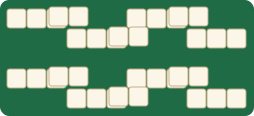
Medium · 36 tiles
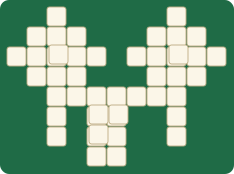
Medium · 46 tiles
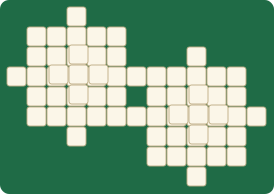
Medium · 68 tiles
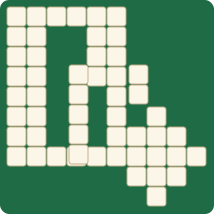
Hard · 52 tiles
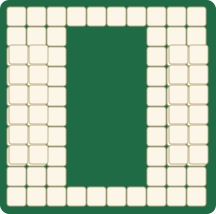
Medium · 92 tiles
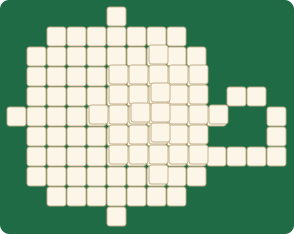
Hard · 122 tiles
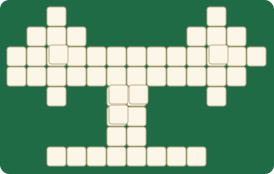
Medium · 54 tiles
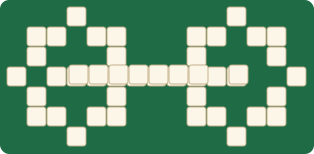
Medium · 48 tiles
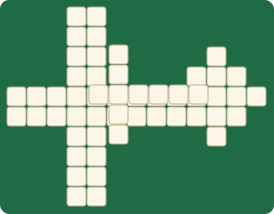
Hard · 56 tiles
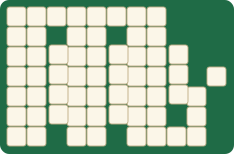
Hard · 60 tiles
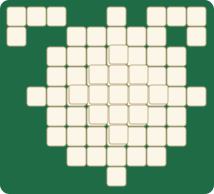
Medium · 70 tiles
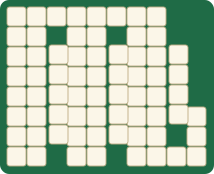
Medium · 68 tiles
Pyramid Mahjong Solitaire · Tower Mahjong · Twin Towers Mahjong · Bridge Mahjong · Cross Mahjong · Diamond Mahjong · Fortress Mahjong · Animal Mahjong · Object Mahjong · Food Mahjong · Holiday Mahjong · Symbol Mahjong · Nature Mahjong · Geometric Mahjong · Easy Mahjong Solitaire · Hard Mahjong Solitaire · Christmas Mahjong · Ocean Mahjong
From the same team — more games, free to play online.