Fortress Mahjong
9 boards · free, no download.
9 boards · free, no download.
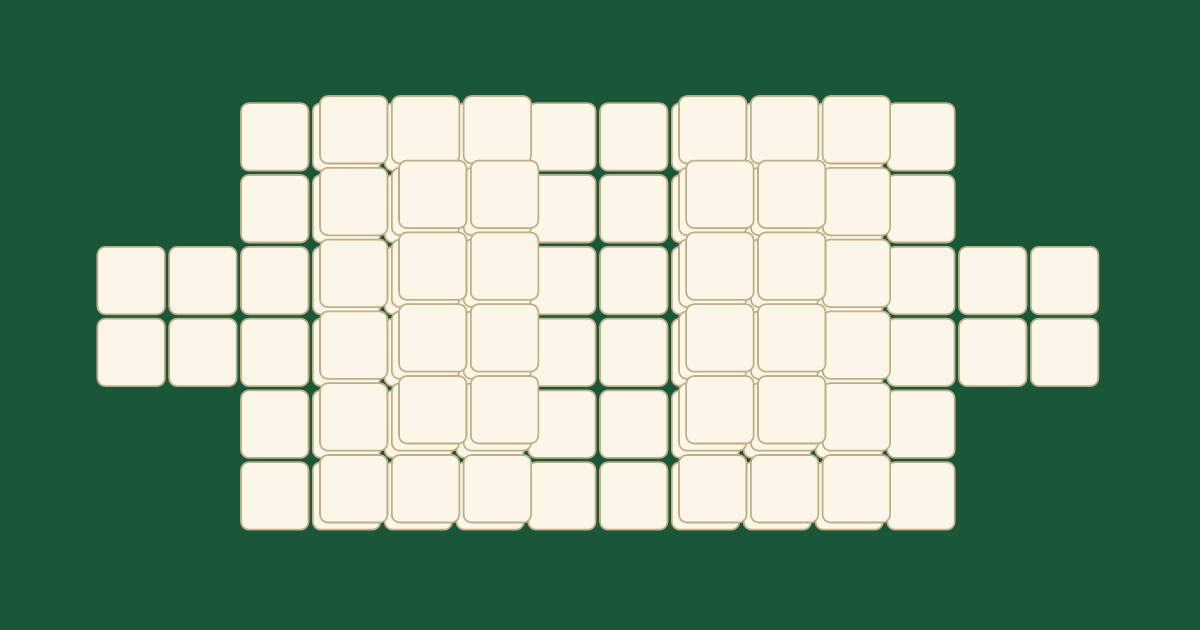
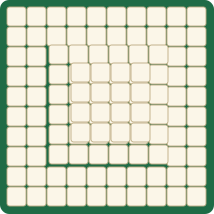
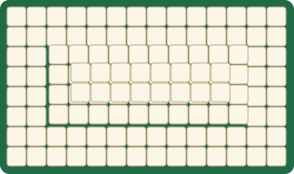
Play Fortress Mahjong free online — instant in your browser, no download, no sign-up. Fortress Mahjong is the family of Mahjong Solitaire boards built to look and play like a stronghold. Where most layouts arrange the 144 tiles into something open or organic, a fortress raises thick outer walls in a closed ring and shelters a defended inner keep at the heart of the board. Many of these boards double the perimeter, setting a second wall just inside the first so the rampart reads as genuinely massive, a barrier two tiles deep rather than one. The whole thing has the squared-off silhouette of a castle seen from above: heavy battlements along each side, bastions at the four corners, and a quiet courtyard of tiles in the middle that the walls plainly guard. You are still playing ordinary Mahjong Solitaire, hunting for matching pairs of free tiles, but the shape turns that hunt into a siege.
What makes the category so appealing is the way that fortified shape changes the order of attack. A double-walled perimeter blocks side access almost everywhere, because a tile pressed between two parallel walls has neighbors on both flanks and cannot be taken. The only soft spots are the corners, where the wall turns and one face pokes out into open space, and the tops of the battlements, which sit above the courtyard with nothing capping them. So you do not grind through the front gate; you breach the fortress the way a real siege would, prying open the corners and upper walls first and working inward until the sheltered tiles in the keep finally come within reach. Clearing one feels less like tidying a pile than taking a castle apart stone by stone, and this hub gathers the whole garrison of them, every one a complete, hand-checked, solvable puzzle.
Mahjong Solitaire is a tile-matching game, not the four-player game of the same name, and its single rule is easy to state: you may remove a pair of identical tiles whenever both are free, meaning nothing rests on top and at least one long side, left or right, is open to empty space. The shape of the layout decides how hard that is, because it governs how many tiles are free at the start and how that supply changes as you play.
A fortress board is defined by enclosure. The tiles are massed into a continuous perimeter wall that runs all the way around and closes on itself, with no open end the way a straight row has. On the double-walled fortresses that perimeter is two tiles thick, an outer rampart and an inner one shoulder to shoulder, so a tile caught in the gap between them is pinned from both sides at once. Sitting inside that ring is the keep, a smaller cluster of tiles in the center, sometimes raised a layer or two into a little citadel, that the walls surround and guard. The empty courtyard between the inner wall and the keep is the breathing room that lets the central tiles open up, but only after the walls above and beside them have come down.
That enclosed geometry is exactly why a fortress plays so differently from an open board. On a long straight wall only the two end tiles are free, but at least those ends exist; on a closed double wall there are no ends at all, only the four corners where the rampart changes direction and the corner tile gains an open flank the dead-straight stretches lack. The battlements, the top course of the wall, are the other weak point, since their upper edge faces open sky with nothing stacked on them. Read a fortress correctly and you stop seeing an impenetrable box and start seeing four soft corners and an exposed crown, which is precisely where the whole thing begins to come apart.
Attack the corners first. On every fortress board the four corners of the outer wall are your way in, because a corner is the one place where a straight wall gives way to an open side, leaving a free edge you can exploit from the opening move while the flat runs between corners stay locked. Clear the corner tiles and the ones braced against them become free in turn, so peeling inward from all four corners at once is how you start unzipping a perimeter that looked completely sealed.
Clear the battlements before the keep. The top course of the wall sits above the central courtyard with open air over it, so those upper tiles are reachable while the courtyard tiles below them are not. Dive for the center while the battlements still stand and you will stall, since the keep tiles stay locked under and behind the wall towering over them. Bring the wall down first, course by course, so the courtyard opens from above, and only then turn to the inner keep. The fortress rewards patience with its own architecture: lower the walls and the center surrenders almost on its own.
Keep the assault balanced on all four sides, and lean on the tools when the walls look sealed. Because the perimeter is symmetrical you usually have a choice of which corner to open next, and the steady way to win is to shave the wall down evenly rather than punching a single hole through one side that strands tiles on the faces you neglect. Early on a fortress can show only a handful of legal moves, almost all at the corners, and that is when a Hint earns its keep, confirming an opening exists rather than playing the board for you. Undo lets you rehearse a breach, opening one corner to see how far inward it reaches before backing out to test another. And if you ever exhaust the legal moves, Shuffle redeals the remaining tiles into a fresh arrangement that is still guaranteed solvable, so a stuck wall becomes a new puzzle instead of a lost game.
This hub gathers a full garrison of fortress boards, spread deliberately across the difficulty range so the same fortified idea can serve a short, gentle round or a long, demanding campaign. The plain Fortress is the canonical version and the right place to learn the shape: a clean walled board that shows the pure form, thick enough to feel like a stronghold but compact enough that the corner-first, walls-before-keep rhythm clicks into place quickly. From there the boards grow in scale and resistance, but the underlying castle logic never changes, so every instinct you build on the basic Fortress carries straight over to the larger ones.
At the heavy end stand the grand strongholds. Supreme Fortress and Mega Fortress push the wall count and tile load toward the upper limit, stacking taller ramparts and a deeper keep so that planning your breach several moves ahead becomes essential rather than optional. Ancient Fortress carries a weathered, time-worn character and plays with a fittingly stubborn solidity, while Hidden Fortress leans into concealment, its layout taking a little longer to read at a glance and rewarding the player who studies the walls before charging them.
Much of the variety, though, comes from themed fortresses that dress the same defensive architecture in a particular look and mood. Lotus Fortress and Jasmine Fortress soften the stronghold with a floral theme, the calm of a flower set against the weight of the walls. Bamboo Fortress leans on the bamboo suit and a natural green palette, a stronghold grown rather than built, while Emerald Fortress glows in deep gemstone green, the rampart reimagined as carved precious stone. Whatever the name on the gate, every layout uses the full traditional set of 144 tiles, the circles, bamboos, characters, winds, dragons, and the bonus flowers and seasons, and every one has been validated as fully solvable from its opening deal. You can choose a fortress by mood, by theme, or by how hard you want the walls to fight back, never worrying that you have picked one that cannot be taken.
Mahjong Solitaire is a modern solitaire game built on the tiles of the centuries-old Chinese game, and it became a computer classic in the 1980s under the name Shanghai, where the original layout was the now-iconic Turtle. The tradition since has been about reimagining one pile of tiles into ever more inventive shapes, and fortresses belong to the architectural branch of that family, the boards designed to resemble built structures rather than animals or abstract symbols. A walled stronghold is one of the most evocative forms that branch can take, because a fortress is a shape humans have read as power and safety for as long as we have piled stone on stone.
There is real pleasure in a layout that looks like something you could lay siege to. A thick double wall with corner bastions and a guarded keep instantly reads as a castle, a citadel, or a frontier garrison, and that mental image gives the puzzle a sense of place. The themed names lean into it from different directions: Ancient Fortress invites you to picture crumbling ramparts that have outlasted whoever built them, Hidden Fortress suggests a stronghold concealed in mountains or forest, and Supreme and Mega Fortress conjure the grandest imperial keep imaginable, while the botanical Lotus and Jasmine boards set the serenity of a flower against the severity of a wall. None of this alters the tiles you match, but it frames clearing the board as breaching defenses and taking a castle, a far more vivid job than removing pairs from a heap.
The shape is also fun for a purely tactical reason: enclosure gives every game a clear, dramatic arc. A fortress opens locked and forbidding, with few moves and an obvious central prize you cannot yet touch, so the early breach at the corners feels like genuinely cracking something open. The walls then come down course by course, the courtyard widens, and the moment the last of the rampart falls and the keep lies exposed delivers a real payoff: the satisfaction of a stronghold taken, the particular reward this category is built to give.
Fortresses sit among the more demanding Mahjong Solitaire shapes, and they are honest about it. The double-walled perimeter deliberately starves you of easy moves at the start, funneling everything through the four corners, so the opening asks more of you than a generously exposed layout like a diamond. A careless early match can cost more here too, because committing a corner the wrong way, or stripping one face while the others stand, can seal a needed tile in the wall. That constraint is what fans of the shape come for: if you enjoy a board that resists you, rewards planning a few moves ahead, and makes the win feel earned, a fortress will engage you in a way an open board cannot.
Difficulty within the family scales cleanly with size and wall depth, so it is easy to find your level. The plain Fortress and the lighter themed boards such as Lotus Fortress or Bamboo Fortress are the place to learn the corner-first habit at a manageable weight, with walls thick enough to teach the siege without overwhelming you. The grand strongholds, Supreme Fortress, Mega Fortress, and Ancient Fortress, demand sustained concentration and real multi-move foresight, with deeper ramparts and a stubborn keep that turn the endgame into a real planning exercise as your eye for the soft corners sharpens.
Demanding, though, never means unfair. Every fortress in the set is guaranteed solvable from the deal, the Shuffle always redeals into another solvable arrangement, and Undo and Hint are there whenever the walls feel impenetrable. That combination, a board that fights back paired with a safety net that keeps every siege winnable, is what makes Fortress Mahjong rewarding rather than frustrating. These boards suit the thoughtful, unhurried player who comes to Mahjong Solitaire to unwind with a real challenge: nothing here is timed or punishing, so you bring the patience and the fortress supplies a siege you can, eventually, always win.
Because the corners are the only soft spot in a closed wall. A tile is playable only when it has an open side and nothing on top, and along the straight runs of a fortress wall the tiles are wedged between their neighbors with no open flank, especially on the double-walled boards where a tile is pinned from both sides. At each corner the wall turns a right angle, leaving the corner tile and its neighbors a free edge from the very first move. Clearing them frees the tiles braced against them, so working inward from all four corners opens a perimeter that otherwise looks sealed.
Bring the walls down first. The inner keep is surrounded, and on the layered boards it may be raised a level too, so its tiles stay blocked while the rampart still stands over and beside them. The battlements are reachable early because their upper edge faces open space, so clear the walls course by course until the courtyard opens from above, and only then turn to the center. If the keep still looks frozen, a wall tile is usually still propping it up, so scan the perimeter for a corner pair you skipped before assuming you are stuck.
Generally yes, and that is the point of the category. The enclosed double wall deliberately limits your moves at the start, funneling them through the four corners, so a fortress asks for more planning than an open shape that exposes tiles on every side, and it punishes hasty play more, since stripping one face while the others stand can seal a tile inside the wall. For players who like a board that resists them and rewards reading the structure ahead, that difficulty is exactly the appeal; if you prefer a gentler start, begin with the plain Fortress before moving up to Supreme or Mega Fortress.
No fortress in this collection can be dealt unwinnable. Every board is validated to be fully solvable from its opening deal, so a winning order of moves always exists; running out of moves means the pairs were taken in the wrong sequence, not that the board was impossible. Use Undo to back up and try a different line, or Shuffle for a clean reset, which redeals the remaining tiles into another arrangement that is also guaranteed solvable. As for where to begin, start with the plain Fortress to learn the corner-first, walls-before-keep rhythm, then take on the larger strongholds like Ancient Fortress, Supreme Fortress, and Mega Fortress once that habit feels natural.
Hard · 120 tiles
Master · 126 tiles
Expert · 88 tiles
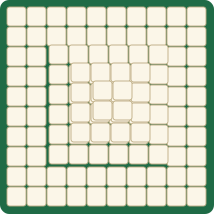
Master · 120 tiles
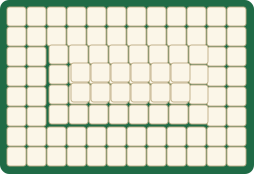
Expert · 108 tiles
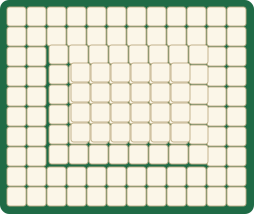
Master · 144 tiles
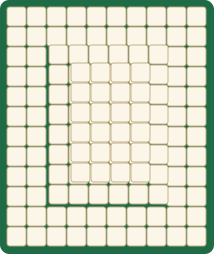
Master · 144 tiles
Expert · 116 tiles
Master · 128 tiles
Pyramid Mahjong Solitaire · Tower Mahjong · Twin Towers Mahjong · Bridge Mahjong · Cross Mahjong · Diamond Mahjong · Zodiac Mahjong · Animal Mahjong · Object Mahjong · Food Mahjong · Holiday Mahjong · Symbol Mahjong · Nature Mahjong · Geometric Mahjong · Easy Mahjong Solitaire · Hard Mahjong Solitaire · Christmas Mahjong · Ocean Mahjong
From the same team — more games, free to play online.