Nature Mahjong
24 boards · free, no download.
24 boards · free, no download.
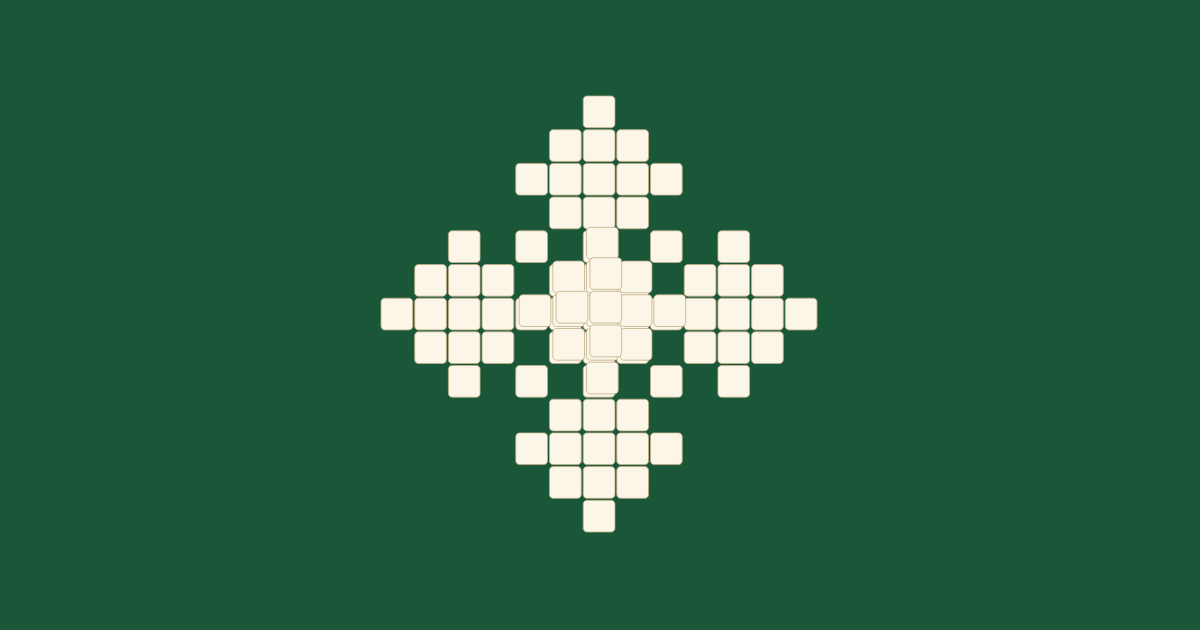
Play Nature Mahjong free online — every board loads instantly in your browser, no download, no sign-up. Nature Mahjong gathers every board in our collection that is built in the shape of something you would find outdoors, a piece of the natural world rendered in 144 stacked tiles. Instead of a neat pyramid or a pair of matching towers, these layouts trace a single flower in full bloom, a pine tree, a ridge of mountains, a rolling wave, a rising sun, a thin crescent moon, a drifting cloud, a falling leaf, a single raindrop, a snowflake, a mushroom, a fork of lightning, a desert cactus, a smoking volcano, an arching rainbow, or a floating iceberg. The rules underneath never change from classic Mahjong Solitaire: you clear the board by removing identical tiles two at a time, and a tile can only be taken when nothing rests on top of it and at least one of its left or right edges is open. What changes is the scenery those tiles form, and because every natural shape has its own contour, each board hands you a different puzzle of which tiles are free at the deal and which are pinned until later.
The appeal of this corner of the game is its calm, scenic feel. Where many themed boards are playful or busy, the nature shapes lean quiet and unhurried, the kind of picture you would be happy to sit with on a slow afternoon, a leaf, a snowflake, a wave caught mid-curl. There is a gentle pleasure in watching a familiar piece of the outdoors come apart pair by pair: a rainbow fades band by band, a tree loses its outer branches before the trunk gives way, a mountain range erodes from its thin peaks down into the heavy rock below. Organic forms also play differently from rigid ones, because almost all of them taper at the edges, so the thin tips and outer curves open first and the dense core holds out until the end. This page pulls all of those nature-shaped boards together in one place, every one of them guaranteed solvable from the deal, so you can pick whichever piece of scenery suits your mood and clear it tile by tile at your own pace.
Nature Mahjong is not a different game with new rules. It is classic Mahjong Solitaire, the same matching game sometimes called Shanghai or turtle Mahjong, presented on boards whose footprint has been sculpted to resemble something from the natural world. Every board still uses the standard 144-tile set: the three numbered suits of Circles, Bamboo and Characters running one through nine in four copies each, the four Wind tiles and the three Dragon tiles in red, green and white among the honors, and the eight bonus tiles, the four Flowers and the four Seasons. None of that changes from board to board. What changes is the layered map those tiles sit on, and in this category that map traces the outline of a flower, a tree, a mountain, a wave or another scene from outdoors.
Because the silhouette is the scenery and not a tidy rectangle, the playing field has a shape you can feel. A pine tree is wide and shallow at the bottom and narrows to a point at the crown, so the board is broad at one end and thin at the other. A rainbow is a set of arcing bands with empty space beneath the arch, so there is no solid center to anchor your eye. A snowflake throws out six identical arms from a small dense hub, which means most of the board is delicate spokes around a stubborn middle. A volcano is a broad heavy cone with a plume rising from its mouth, mass at the base and a thin trail of tiles at the top. These contours decide which tiles are free and which are buried, and reading that geography is the whole strategic puzzle.
A tile is free, and therefore matchable, when it has no tile resting on top of it and at least one of its left or right long edges is open. Two free tiles that show the same face can be removed together: any Circle five pairs with any other Circle five, the Red Dragon pairs with the other Red Dragon, and so on through the set. The Flowers form one matchable group among themselves and the Seasons form another, so any Flower clears with any other Flower and any Season with any other Season even though their pictures differ. On every nature board the flowers and seasons are genuine flowers and seasons, paired correctly, so whenever two of either turn up free you can clear them without hunting for one exact match. Clear all 72 pairs and the scene is empty. The natural shape simply decides the order in which those pairs become reachable.
The single most useful habit on these boards is to read the scene before you touch a tile. Organic shapes share one defining trait: they taper. A flower thins to the tips of its petals, a tree to the ends of its branches, a mountain to its peaks, a wave to its curling crest, a leaf to its pointed end and serrated edges. Those thin tips and outer curves are where tiles are shallowest and most likely to have an open edge from the very first move, while the body, the trunk, the base of the range, the heart of the bloom, is the densest, most stacked part and almost always the final stretch. Open the thin tips and outer curves first, then work steadily inward toward the dense center. That one instinct unlocks the large majority of nature boards.
Knowing that, your early job is to harvest the edges without sealing off the interior. The tiles around the outline of any natural shape are mostly free at the start, which is tempting, but clearing them at random can strand the one or two that were quietly propping open a route inward. Before you take an easy outer pair, glance at what sits one layer deeper and ask whether removing this tile keeps a path open or closes one. On a shape with two symmetrical halves, a snowflake's six arms, a leaf's two sides of veins, a rainbow's mirrored ends, advance the matching features at a similar pace rather than stripping one side bare, because pairs are often split so that one tile lives in the left arm and its twin in the right. Peel symmetrical features together and split pairs stay reachable on both sides.
Matching in fours is the quiet skill that wins long boards. When all four copies of a tile are exposed at once, clearing all four removes a dead end with no downside. But when only two of the four are showing and the other two are buried in different parts of the scene, pause: removing the visible pair might be the very thing that frees the deeper structure, or it might waste a match you will badly want later to dig out a stack. On the heavy parts of these shapes, the trunk of the tree, the rock of the mountain, the cone of the volcano, prefer matches that physically peel a layer off the top so the board keeps opening up beneath your fingers, rather than matches that clear two flat edge tiles and reveal nothing new.
Use your safety nets without guilt, because this category is built to be enjoyed rather than to punish you. The Hint button surfaces an available pair when you genuinely cannot find one, which is easy on a busy shape like a cactus or a cloud where a legal move can hide in plain sight. Undo lets you step back a match you regret, and on these boards a single early edge tile can be the difference between an open path and a stall, so the ability to walk one move back is worth having. And if the layout has tangled into a position you do not like, Shuffle re-deals the remaining tiles into a fresh arrangement that is again guaranteed solvable, so a reshuffle is a true reset rather than a trap. A careless early match never permanently dooms a game; you can always read the scene again, take the match that opens the most, and play the round through to a clean finish.
The nature hub is deliberately varied so that no two sittings feel the same, and the boards split naturally into a few families by how their forms behave. The botanical shapes are the gentlest introduction. The Flower opens from the tips of its petals inward toward a dense center, the Tree sheds its outer branches and leafy crown before the trunk gives way, the Leaf clears along its pointed tip and serrated edges down to the central vein, the Mushroom frees the rim of its cap before the stout stem, and the Cactus pulls apart along its raised arms before the thick column. These taper cleanly and open generously, which makes them an easy, low-stress place to warm up or to spend a quiet twenty minutes.
The water and weather shapes give the category its sense of motion. The Wave curls from its thin crest down into the heavier swell, the Raindrop tapers to a point at the top and rounds out below, the Cloud is a cluster of soft rounded lobes with open edges all around, and the Snowflake throws six delicate arms out from a small hub so most of the board is spokes around a tight middle. The Lightning Bolt is the odd one out, a thin jagged zigzag that is narrow almost everywhere, so its matches travel along a crooked line rather than concentrating in a mass. The Iceberg shows a smaller peak above and a broad heavy bulk below, mass hiding under the waterline, so the visible tip clears first and the submerged body is the long final grind.
Then there are the landscape and sky shapes that carry the most personality. The Mountain Range is a row of peaks, thin and quick to open at the summits, dense and stubborn through the rock at the base, so you work the skyline down into the bulk. The Volcano is a broad cone with a plume rising from its mouth, the thin trail of smoke comes apart first and the heavy base holds out last. The Sun is a solid disc ringed by radiating points, the outer rays free up before the body of the disc. The Crescent Moon is a slim curving sliver, narrow throughout and open along both edges of the arc. The Rainbow is a set of stacked arcing bands that fade one ribbon at a time from the outer arch inward. Across every one of these the tile count and the rules are identical, which means once you are comfortable on one piece of scenery you can sit down at any other and already understand it; only the landscape in front of you is new.
Picture-shaped Mahjong is a long tradition, and the natural world is one of its oldest wells of inspiration. Almost everyone meets the game first as the classic turtle, a fat layered mound that loosely resembles a tortoise shell, and from that animal beginning layout designers have spent decades bending the 144-tile set into every kind of figure. Nature is woven into the tiles themselves, the green and red Dragons among the honors, the four Seasons marking spring through winter, the Flowers that traditionally depict plum, orchid, chrysanthemum and bamboo, the Bamboo suit named for a living plant. Shaping a whole board into a leaf or a mountain simply extends that heritage outward into the layout, turning the entire playing field into a small scene from outdoors rather than an abstract structure.
What makes the shapes genuinely fun to play, rather than merely nice to look at, is that the scenery guides the puzzle in a way you can feel. On a plain pyramid the layers are uniform and one corner plays much like another. A piece of nature has a thin edge and a thick core, a crest and a swell, a crown and a trunk, and those features create real differences in how the tiles open up. Unwinding the curl of a wave, fading a rainbow band by band, eroding a mountain range from its peaks, or melting the visible tip of an iceberg down to nothing each feels distinct because the underlying structure genuinely differs. The theme is not just paint over a standard grid; it shapes the order of play and gives every board a quiet little arc as it empties.
There is also a particular calm to this category that sets it apart from the busier themes. A rainbow, a snowflake, a single drifting cloud, a leaf turning in the air, these are restful images, and clearing them has an unhurried, almost meditative quality. Because the silhouette is something you recognize from the world outside, watching it come apart is more satisfying than watching an anonymous block shrink, and the subjects themselves invite a slower pace. That sense of a peaceful scene gently dissolving under your hands, the wave settling, the volcano going quiet, the mountains worn flat, is a small reward the nature theme delivers that a purely geometric board cannot.
As a group, the nature boards sit comfortably in the easy-to-moderate range of Mahjong Solitaire, which is exactly why they make such a welcoming place to play. Difficulty here varies more by shape than along a single rising scale, because each form's contour decides how forgiving it is. The botanical shapes, the flower, the tree, the leaf, the mushroom, are the most generous, tapering cleanly so that plenty of edge tiles are free from the opening and you rarely feel boxed in. The thin, winding forms such as the crescent moon and the lightning bolt are open along their length and gentle in their own way, asking you to work steadily along a line. The shapes dominated by a single heavy mass, the volcano, the iceberg, the base of a mountain range, are kinder at the edges but ask for a little more patience through the dense final stretch.
The challenge on these boards is one of reading and discipline rather than brute complexity. The trap that catches people is the same on almost every scene: clearing one side of a symmetrical shape far ahead of its mirror and stranding a split pair, or digging greedily into the dense body before the thin edges that pin it have been thinned out. Both pitfalls are matters of pacing and a little forethought, not of untangling a chaotic mass, which keeps the difficulty feeling fair and learnable. Once you internalize the habit of opening the tips and outer curves first and advancing symmetrical features in step, most nature boards open up smoothly, and the harder ones simply give that discipline more room to be tested.
These boards suit casual and older players especially well. The matching is simple, the shapes are instantly legible, the tiles are large and clear, and the whole experience is calm by design. There is no clock forcing your hand and no level you must beat to move on, so you are free to study the scene, take the match that opens the most, and enjoy the deliberate teardown at your own pace. If you like a quiet game with a cup of tea, somewhere to rest your attention without stress, the nature category is built for exactly that, and its restful subjects make it one of the easiest corners of the game to settle into.
More experienced solvers still find plenty to enjoy here, just in a different register. The fun for a confident player is in playing efficiently, reading the draining order at a glance, matching in fours wherever it is safe, and clearing a snowflake or a rainbow cleanly without ever reaching for Hint or Shuffle. Because nothing is locked behind progress and every board stands on its own, a good way to explore the hub is to start with a forgiving botanical shape like the Flower or the Tree, get comfortable balancing symmetrical features, then move on to the heavy masses of the Volcano and Iceberg and the delicate spokes of the Snowflake as your reading sharpens. Whichever camp you fall into, the promise is the same on every board in this hub: a fair, finishable, good-looking puzzle shaped like a piece of the outdoors, with no streak to protect and no penalty for putting it down.
It is a group of Mahjong Solitaire boards whose tile layouts are shaped like things from the natural world rather than like geometric figures such as pyramids or towers. The hub gathers many of them, including the Flower, Tree, Mountain Range, Wave, Sun, Crescent Moon, Cloud, Leaf, Raindrop, Snowflake, Mushroom, Lightning Bolt, Cactus, Volcano, Rainbow and Iceberg. The rules are exactly the standard ones, you remove identical tiles in pairs until the board is clear, but each natural shape creates its own pattern of which tiles start free and which are pinned, so every scene plays a little differently.
Open the thin tips and outer curves first, then work inward toward the dense center. Organic shapes taper, so the ends of a flower's petals, a tree's branches, a mountain's peaks or a wave's crest are the shallowest tiles and the most likely to have an open edge from the first move. Clearing those early opens fresh options without a risky dig into the heavy core. On symmetrical shapes like a snowflake or a leaf, advance the matching halves at the same pace so you do not strand a split pair, and save the dense body, the trunk, the base, the heart of the bloom, for last.
Yes. Every board in this hub is generated and checked so that at least one complete winning path exists from the moment it is dealt, clearing all 72 pairs from the thin edges through to the dense core. You will never be handed a layout that is impossible to finish. If a game feels stuck, the remaining path depends on a tile you have not freed yet rather than the board being unwinnable, so reading the scene again usually reveals the move you missed. If you genuinely run dry, the Shuffle button re-deals the tiles you have left into another arrangement that is again guaranteed solvable, so a reshuffle is a fair reset and never a dead end.
Yes, exactly as in standard Mahjong Solitaire. The four Flower tiles all match one another even though their pictures differ, and the four Season tiles all match one another the same way. They are paired correctly on every nature board, so any free Flower can be cleared with any other free Flower, and any free Season with any other free Season. They behave as two special groups rather than needing an identical-face match, which makes them handy for clearing a part of the scene that might otherwise block your path, and it means you are never left waiting on one specific tile to finish a board off.
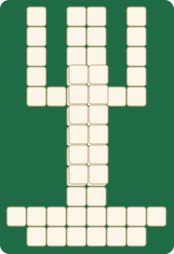
Hard · 58 tiles
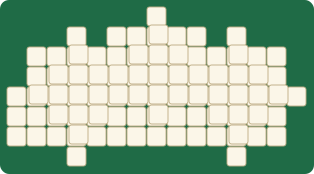
Medium · 118 tiles
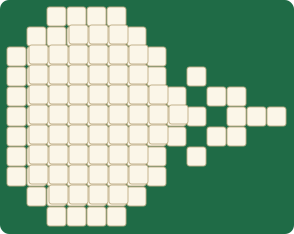
Medium · 142 tiles
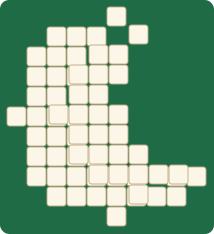
Medium · 64 tiles
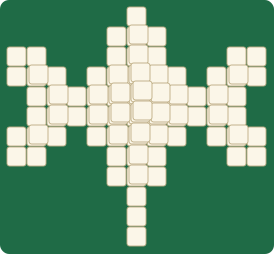
Expert · 106 tiles
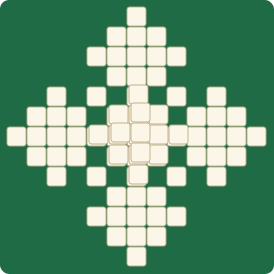
Hard · 82 tiles
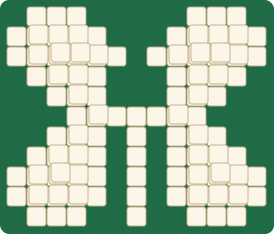
Hard · 140 tiles
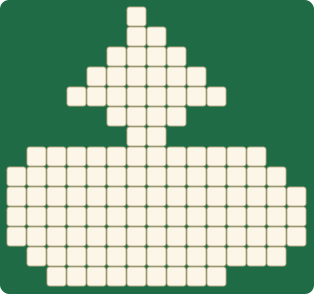
Hard · 120 tiles
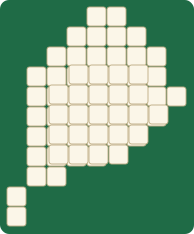
Medium · 72 tiles
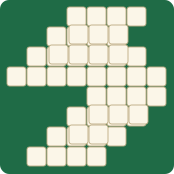
Medium · 50 tiles
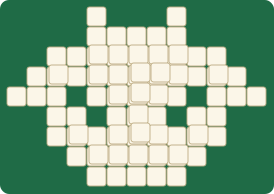
Hard · 96 tiles
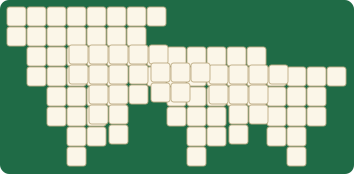
Hard · 102 tiles
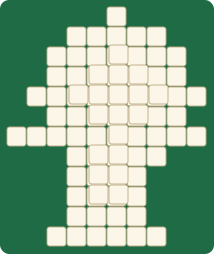
Medium · 88 tiles
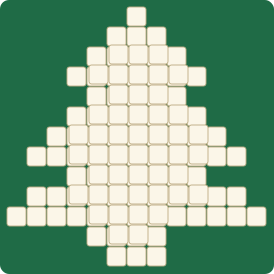
Medium · 134 tiles
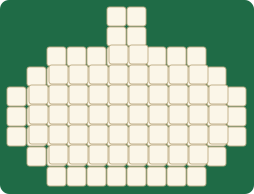
Hard · 124 tiles
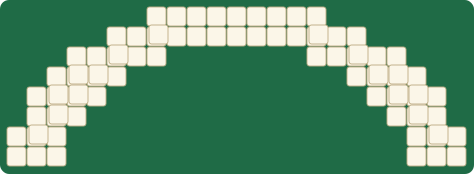
Medium · 82 tiles
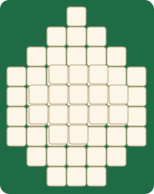
Medium · 60 tiles
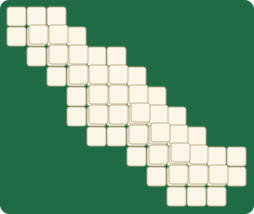
Medium · 74 tiles
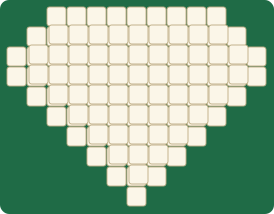
Medium · 138 tiles
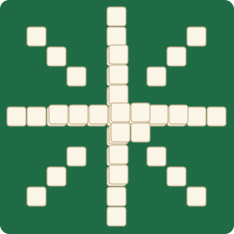
Hard · 50 tiles
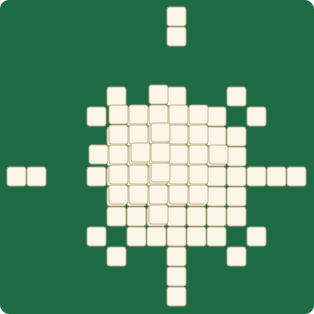
Hard · 98 tiles
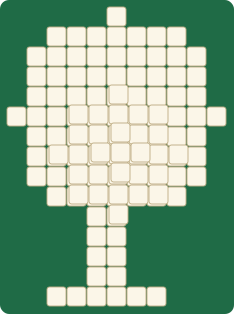
Hard · 128 tiles
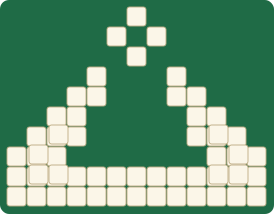
Hard · 60 tiles
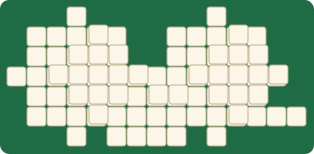
Medium · 96 tiles
Pyramid Mahjong Solitaire · Tower Mahjong · Twin Towers Mahjong · Bridge Mahjong · Cross Mahjong · Diamond Mahjong · Fortress Mahjong · Zodiac Mahjong · Animal Mahjong · Object Mahjong · Food Mahjong · Holiday Mahjong · Symbol Mahjong · Geometric Mahjong · Easy Mahjong Solitaire · Hard Mahjong Solitaire · Christmas Mahjong · Ocean Mahjong
From the same team — more games, free to play online.