Cross Mahjong
31 boards · free, no download.
31 boards · free, no download.
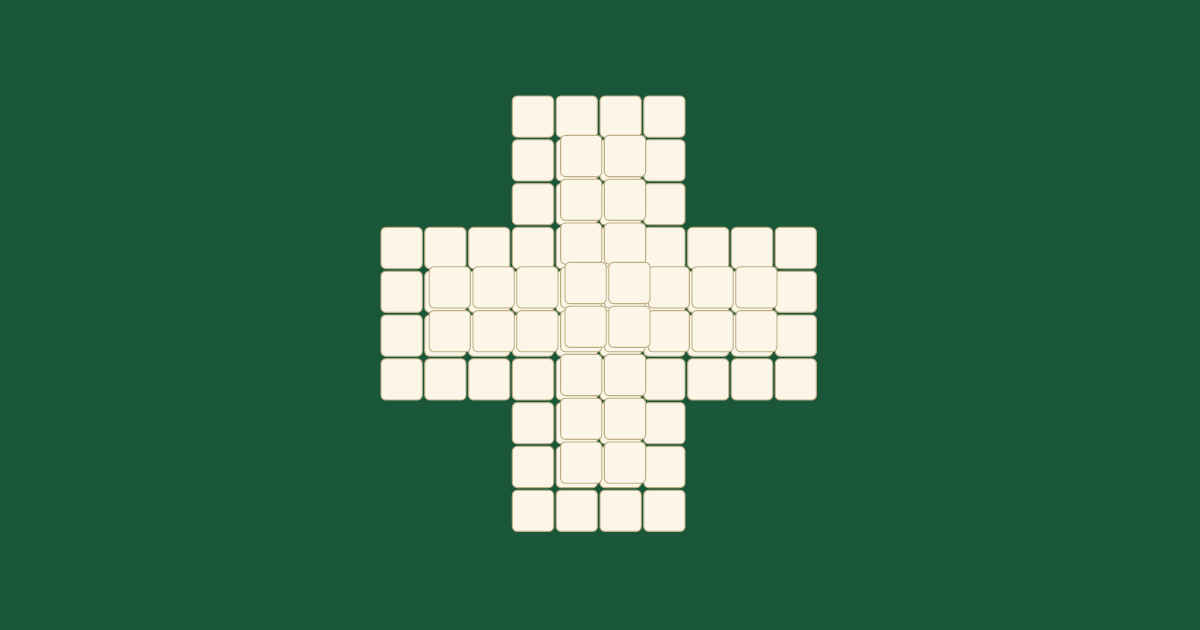
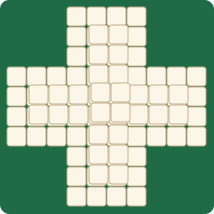
Play Cross Mahjong free online — every board starts instantly in your browser, nothing to download. Cross Mahjong is the family of boards built around one of the oldest and most satisfying shapes in tile-matching: a bold plus sign with four arms stretching out from a raised center. Instead of a wide rectangular slab of tiles, the cross gives the layout breathing room. The four arms are slim corridors you can read at a glance, and the hub where they meet is where the layers stack up and the real puzzle lives. The first time you see a cross board you understand it instantly, which is a big part of why so many players keep coming back to it. There is nothing to decode about the silhouette. You can see where you are meant to start and roughly where you will finish before you have made a single move.
What makes this category worth a whole collection rather than a single board is how far the basic shape stretches. A single-layer cross is a gentle warm-up you can finish in a few relaxed minutes. Pile up three or four tiers in the middle and add a little width to the arms and you have a thinker that rewards patience and planning. Across the set you will find quiet, jewel-themed crosses, moonlit lunar variants, ivory and velvet finishes, and a few that double the shape up entirely. Every board here is guaranteed solvable from the deal, so the challenge is always honest tile-reading and sequencing rather than luck. If a board ever feels stuck, Shuffle re-deals the remaining tiles into another solvable arrangement, so you are never punished for exploring a line that did not pan out.
Mahjong Solitaire takes a set of 144 tiles and stacks them into a three-dimensional layout. You clear the board by removing matching pairs, and a tile can only be taken when it is free: nothing stacked on top of it, and at least one of its left or right edges open so you can slide it out. The shape of the layout is simply the arrangement of those tiles, and it controls everything about how a board plays. The cross is one specific arrangement. Picture a square hub in the middle of the table and four equal arms extending up, down, left, and right from it, so the whole footprint reads as a plus sign or a capital letter X turned upright.
The defining trait of a cross is the contrast between the arms and the hub. The arms are usually thin, often just one or two tiles wide, and frequently a single layer tall. That makes them easy to read and quick to peel apart from the tips inward. The hub is the opposite. It is where the designers stack the extra layers, so the center is denser, taller, and more tangled than anything in the arms. A good cross board uses that contrast deliberately. The arms hand you a generous supply of free tiles right away, which keeps the opening relaxed, while the layered hub holds back the harder decisions for the middle and end of the game.
Because the four arms point in four different directions, a cross naturally gives you open ends on all sides at once. Compare that to a solid rectangle, where the only freely accessible tiles are around the outer rim and the interior is locked until you chip your way in. The cross flips that feeling. The accessible frontier surrounds the puzzle from four sides, and the locked-up part sits in the middle where you can keep an eye on it the entire time. That visibility is a quiet pleasure of the shape: you almost always know what you are working toward.
Start at the four arm-tips. The very end tile of each arm is always free, because nothing can be stacked beyond the edge of the board and one side is automatically open. Those four tips are your reliable entry points, and on most cross boards a handful more tiles just behind the tips are free or one move away from free. Open the game by matching whatever pairs the arm-tips and their neighbors offer you, and you will quickly create a clear runway down each arm.
Then eat inward, but do it evenly. The single most useful habit on a cross is to advance all four arms at a roughly similar pace rather than racing one arm all the way to the hub while the others sit untouched. The reason is that the central hub is usually reachable from more than one side, and each arm you clear opens a fresh approach into the middle. If you strip one arm completely but leave the other three full, you have given yourself exactly one angle of attack on the densest part of the board. Keep all four moving and you arrive at the hub with four open doorways instead of one, which is the difference between a board that unties itself and a board that jams.
Watch your duplicates before you commit a pair. Most tile faces appear four times in the set. When you can see two free copies of a tile, pause and ask whether removing them now strands the other two. A classic cross trap is matching a pair on an arm to make quick progress, only to discover that the two matching tiles you needed were buried in the hub under a layer you have not reached yet. When you are unsure, prefer the match that frees up the most tiles underneath, since clearing covered tiles is what keeps your options multiplying.
Treat the very center as the finish line. On a layered cross the topmost hub tiles and the deepest central tiles are almost always the last to come off. Do not fight that. Use the arms to feed you easy matches early, save your flexible pairs for when the hub finally opens, and let the center be the natural climax of the solve rather than something you try to force open in the first minute. If you find yourself with no move and tiles still on the board, that is what Shuffle is for: it redeals the remaining tiles into a fresh solvable layout so you can take another run at the hub.
This hub gathers a wide span of cross boards so you can pick the weight that suits your mood. At the lighter end sit the cleaner single-tier and lightly layered crosses, where the arms do most of the work and the hub is only a little raised. Cross itself is the plain, definitive version of the shape, the one to play first if the category is new to you. From there the family branches into finishes and themes: Velvet Cross and Velvet Cross II carry a soft, deep-toned look, while Silver Cross, Golden Cross, Ivory Cross, and Ivory Cross II lean into bright metallic and bone-pale palettes that make the tile faces pop.
The jewel crosses are a series in their own right. Sapphire Cross, Emerald Cross, and the Topaz Cross pair (Topaz Cross and Topaz Cross II) each take the shape and dress it in a single gemstone color, and they tend to sit in the middle of the difficulty band: enough layering in the hub to make you think, not so much that they become a marathon. If you enjoy working through a themed run, playing the gem crosses back to back is a pleasant way to spend an evening, since the shared shape lets your tactics carry over while the changing art keeps each board feeling fresh.
The Lunar Cross line is the deepest sub-series here, running from Lunar Cross through Lunar Cross II and Lunar Cross III. These moonlit boards generally build up the most in the center, so they reward the even-arms discipline more than any others in the set. Then there are the shape-benders. Ancient Cross gives the silhouette a weathered, time-worn character. Double Cross does exactly what its name promises and works the cross motif twice over, making it the standout choice when you want the familiar shape pushed into something larger and more demanding. Between the gentle openers and the dense finishers, the collection covers everything from a five-minute palate cleanser to a proper sit-down challenge.
The cross is one of those forms that feels older than the game it appears in. A plus or an X is among the first shapes any of us learn to draw, and it carries a built-in sense of balance and completeness. In tile games the cross has been a go-to silhouette for a long time precisely because it photographs well on a screen and reads instantly to a player of any age. There is a reason designers return to it again and again: it is symmetrical, it is recognizable, and it frames a clear center stage where the most dramatic part of the puzzle can unfold.
Part of the appeal is purely visual. A cross sitting in the middle of the table, arms outstretched and a little tower of tiles glinting at the hub, simply looks inviting in a way a dense block does not. The negative space around the arms gives your eye somewhere to rest, and on the themed boards that empty space lets the velvet, ivory, or gemstone art breathe. Many players in this collection tell us the look is half the reason they choose a cross over a busier layout when they want to unwind.
The other half is how the shape feels under your hands as you solve it. Because the four arms collapse inward toward a shared center, a well-played cross has a real sense of momentum. You begin spread out across four fronts, and as the arms shorten, the whole board seems to draw together until everything that is left is concentrated in the hub. That gathering motion gives a cross a satisfying shape of its own, a beginning, a middle, and an end that you can feel rather than just count. Finishing the last pair at the dead center of the cross is one of the more quietly rewarding moments in the whole game.
As a category the cross sits comfortably in the easy-to-moderate range, which is exactly why it is such a good home base. The arms guarantee a friendly opening on every board, so you are never staring at a wall of locked tiles wondering where to begin. That makes the whole collection welcoming to newcomers and a relaxed choice for players who want a clear, low-stress puzzle rather than a brain-melting one. If you are returning to Mahjong Solitaire after a break, a single-layer cross is one of the gentlest ways back in.
The difficulty climbs in a smooth, predictable way as you move through the set, and it climbs almost entirely in the hub. Add layers to the center and the same arm-clearing tactics still apply, but now the timing of when you open the hub matters more, and a careless early match can leave a needed tile buried until late. The Lunar Cross boards and Double Cross are where this collection asks the most of you, so they make a natural step up once the basic crosses feel automatic. Even at their hardest, though, these boards stay fair: every layout is solvable from the deal, the flowers and seasons are arranged so their group matches are always honest, and Shuffle is there whenever a position dries up.
All of which makes the cross a fine fit for the relaxed player above all. It suits anyone who likes a puzzle they can read at a glance, who would rather plan a tidy sequence than scramble against a clock, and who enjoys the small ceremony of clearing a shape from the outside in. Newcomers can learn the whole game on these boards. Veterans can use the lighter crosses to warm up and the dense ones to test their sequencing. And if you simply want to sit down with a cup of tea and untangle something pleasant for ten or twenty minutes, the cross was practically made for it.
Start at the four arm-tips. The tile at the very end of each arm is always free, because the board edge leaves one side open and nothing can sit on top of a tip. Clear the tips and the tiles just behind them, then keep working down all four arms. Those ends are your most reliable supply of free tiles, so they are where almost every cross board wants you to begin.
The center hub is the densest and most layered part of a cross, and it is meant to be the last thing you clear. Getting stuck there usually means you raced one arm to the middle and left the others full, so you only have one way in. Clear all four arms at a similar pace instead, which opens the hub from several sides at once. If a position truly has no moves left, use Shuffle to redeal the remaining tiles into a fresh solvable layout.
The plain, lightly layered crosses are the easiest, with Cross itself being the best place to start. The single-gem boards like Sapphire Cross, Emerald Cross, and the Topaz Cross pair sit in the middle. The toughest are the heavily stacked ones: the Lunar Cross series, which piles the most tiles into the center, and Double Cross, which works the whole shape twice over. The difficulty rises mostly in the hub, so the arms stay friendly even on the harder boards.
Yes. Every board in this collection is dealt so that a complete solution exists from the start, so any board you open can be finished with the right sequence of matches. If you reach a point with no legal moves remaining, the Shuffle option redeals the tiles still on the table into another arrangement that is also solvable, and the flower and season tiles are always grouped so their matches are fair. You are never beaten by a bad deal, only by tile order you can replan.
Hard · 96 tiles
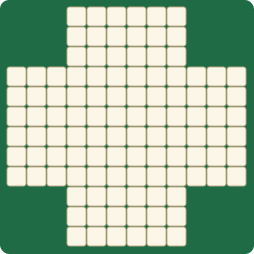
Expert · 108 tiles
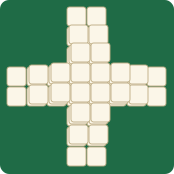
Hard · 60 tiles
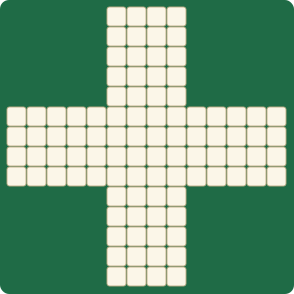
Hard · 96 tiles
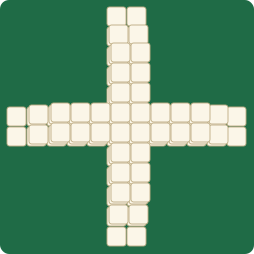
Expert · 108 tiles
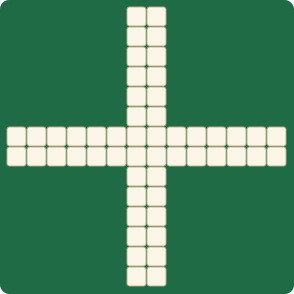
Medium · 52 tiles
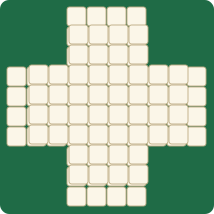
Expert · 112 tiles
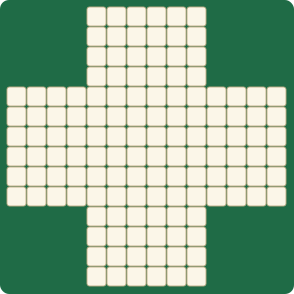
Expert · 132 tiles
Expert · 96 tiles
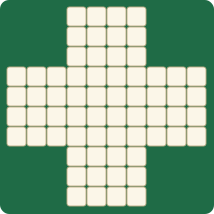
Medium · 64 tiles
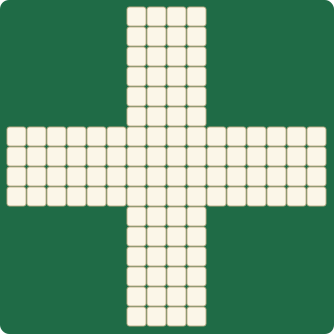
Expert · 112 tiles
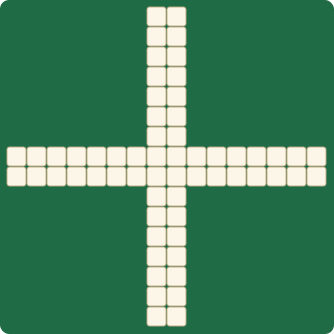
Medium · 60 tiles
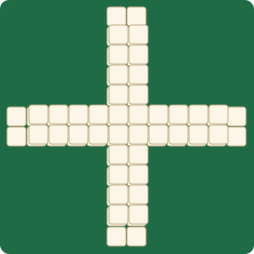
Hard · 80 tiles
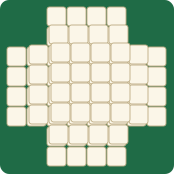
Expert · 96 tiles
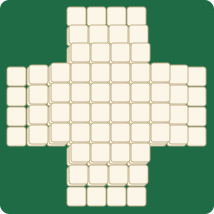
Master · 144 tiles
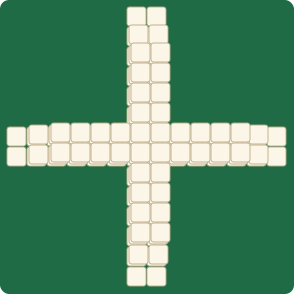
Master · 132 tiles
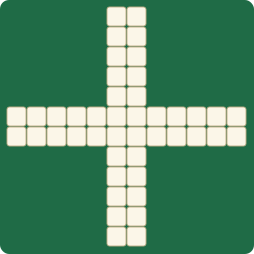
Medium · 44 tiles
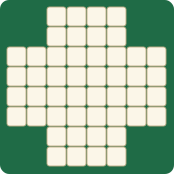
Medium · 48 tiles
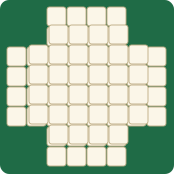
Hard · 80 tiles
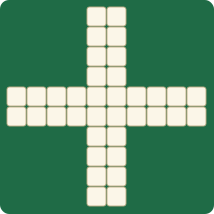
Easy · 36 tiles
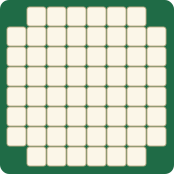
Medium · 60 tiles
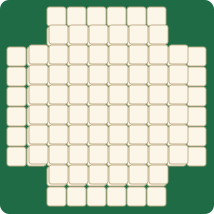
Master · 144 tiles
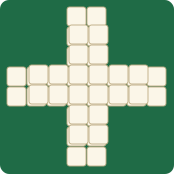
Medium · 48 tiles
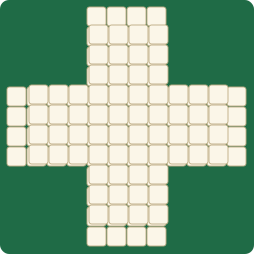
Master · 144 tiles
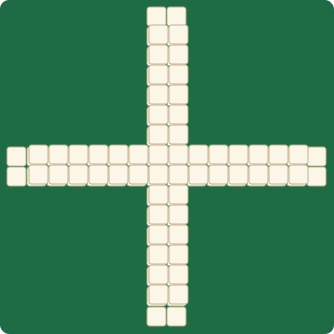
Expert · 112 tiles
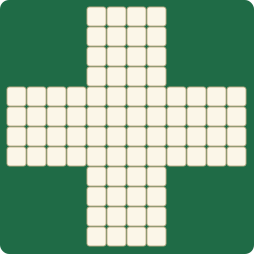
Hard · 80 tiles
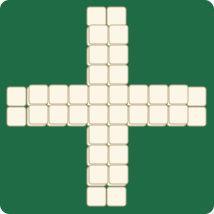
Hard · 64 tiles
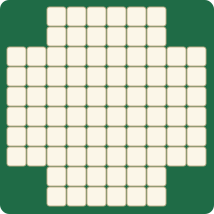
Hard · 84 tiles
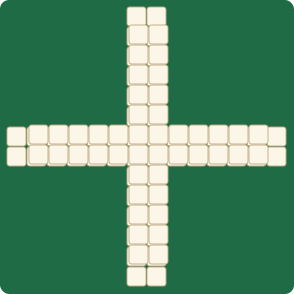
Expert · 96 tiles
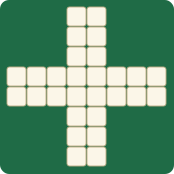
Easy · 28 tiles
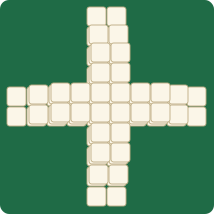
Expert · 84 tiles
Pyramid Mahjong Solitaire · Tower Mahjong · Twin Towers Mahjong · Bridge Mahjong · Diamond Mahjong · Fortress Mahjong · Zodiac Mahjong · Animal Mahjong · Object Mahjong · Food Mahjong · Holiday Mahjong · Symbol Mahjong · Nature Mahjong · Geometric Mahjong · Easy Mahjong Solitaire · Hard Mahjong Solitaire · Christmas Mahjong · Ocean Mahjong
From the same team — more games, free to play online.