Ocean Mahjong
16 boards · free, no download.
16 boards · free, no download.
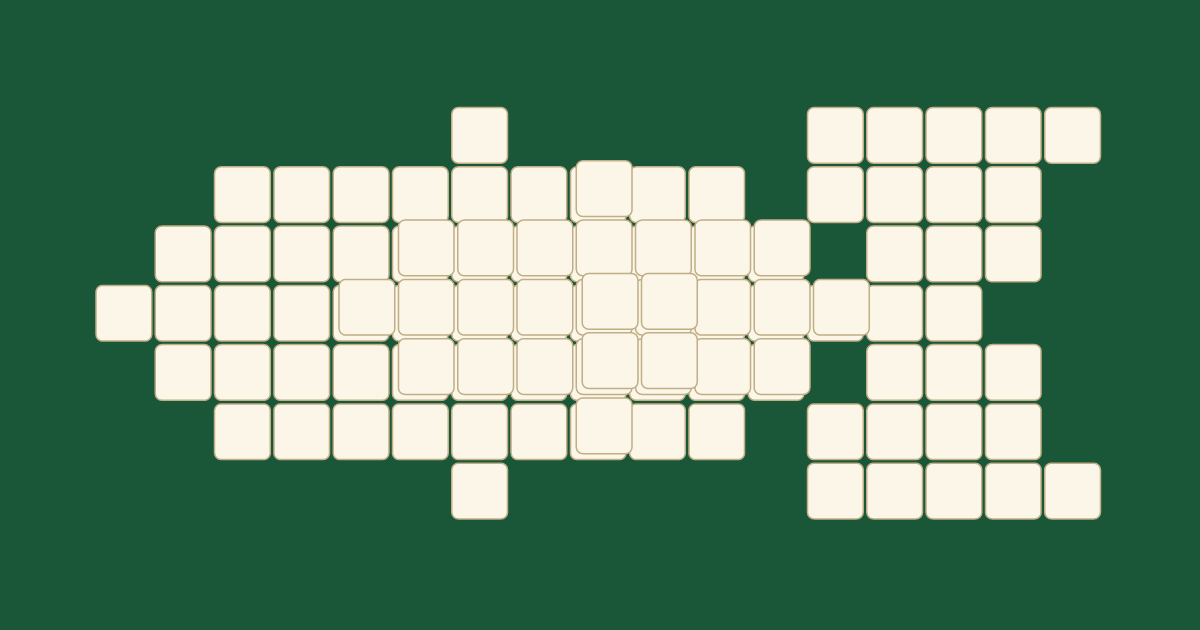
Play Ocean Mahjong free online — every board starts instantly in your browser, no download, no sign-up. Ocean Mahjong gathers every board in our collection that takes its shape from the sea, the 144 tiles arranged not into a tidy pyramid or a pair of matching towers but into the flowing outline of an underwater creature or a piece of seafaring gear. Dive in and you will find an octopus with its eight curling arms, a jellyfish trailing a fringe of tentacles, a stingray gliding on broad wings, a leaping dolphin, a curled seahorse, a wide-clawed crab, a great whale, a darting squid, a manta ray, a starfish, a scallop shell, a snail, a fish, a fish bone picked clean, an anchor and a little sailing boat riding the surface. The rules underneath never change from classic Mahjong Solitaire: you clear the board by removing identical tiles two at a time, and a tile can only be taken when nothing rests on top of it and at least one of its left or right edges is open. What changes is the marine silhouette those tiles form, and because every sea shape has its own contour, each board hands you a different puzzle of which tiles are loose at the deal and which stay anchored until later.
The appeal of this corner of the game is its cool, drifting, underwater calm. Where many themed boards are busy or angular, the ocean shapes flow, they are all soft curves and trailing limbs, the kind of slow, weightless picture you would be happy to sit with on a quiet afternoon. There is a particular pleasure built into how these creatures come apart, because nearly every one trails something loose, a tentacle, a fin, a tail, a feeler, a streamer, and those danglers are exactly the tiles that come free first. You clear the trailing parts, watch the creature gather inward, and finish on the solid body at the heart of the shape. This page pulls all of those sea-shaped boards together in one place, every one of them guaranteed solvable from the deal, so you can pick whichever creature or vessel suits your mood and clear it tile by tile at your own unhurried pace.
Ocean Mahjong is not a different game with new rules. It is classic Mahjong Solitaire, the same matching game some people know as Shanghai or turtle Mahjong, presented on boards whose footprint has been sculpted to resemble something from the sea. Every board still uses the full standard 144-tile set: the three numbered suits of Circles, Bamboo and Characters running one through nine in four copies each, the four Wind tiles and the three Dragon tiles in red, green and white among the honors, and the eight bonus tiles, the four Flowers and the four Seasons. None of that changes from one board to the next. What changes is the layered map those tiles sit on, and in this category that map traces the shape of an octopus, a jellyfish, a dolphin, a whale, an anchor or another marine subject.
Because the silhouette is a sea creature and not a rectangle, the playing field has a shape you can feel in your hands as it comes apart. An octopus is a compact head over a tangle of eight arms that fan and curl outward, so most of the board is trailing limbs around a dense crown. A jellyfish is a rounded bell sitting above a long, thin fringe of tentacles, mass on top and delicate streamers hanging below. A stingray and a manta ray are mostly broad flat wings with a thin whip of a tail trailing behind. A whale is a single heavy bulk with a small tail fluke and fins. A seahorse is a slim S-curve from a curled tail up to a tilted head. These contours decide which tiles are loose and which are buried, and reading that marine geography is the whole strategic puzzle.
A tile is free, and therefore matchable, when it has no tile resting on top of it and at least one of its left or right long edges is open. Two free tiles that show the same face come off together: any Circle five pairs with any other Circle five, the Green Dragon pairs with the other Green Dragon, and so on through the set. The Flowers form one matchable group among themselves and the Seasons form another, so any Flower clears with any other Flower and any Season with any other Season even though their pictures differ. On every ocean board the flowers and seasons are genuine flowers and seasons, paired correctly, so whenever two of either surface free you can clear them without hunting for one exact match. Clear all 72 pairs and the creature is gone. The sea shape simply decides the order in which those pairs rise within reach.
The single most useful instinct on an ocean board is to clear the danglers first, then the body. Sea creatures trail loose parts, the curling arms of an octopus, the tentacle fringe of a jellyfish, the whip tail of a stingray, the fin of a dolphin, the curled tail of a seahorse, the long feelers of a snail. Those trailing parts are where tiles are shallowest and thinnest, only a layer or two deep, and most likely to have an open side from the very first move. Strip the danglers and you open a wave of early options without a risky dig into the dense core, and you gradually expose the place where each limb joins the body. The solid center, the head of the octopus, the bell of the jellyfish, the bulk of the whale, the disc of a scallop shell, is almost always the final stretch, so treat the trailing parts as your warm-up and the body as the main event.
Watch closely for pairs split between two matching limbs, which is the defining tactical wrinkle of these flowing shapes. A creature with several similar appendages, an octopus with eight arms, a crab with two big claws and a row of legs, a starfish with five points, a jellyfish with a row of tentacles, will often hide one tile of a pair in one limb and its twin in another. Strip one arm of the octopus completely bare while ignoring the others and you can strand a tile whose only partner is locked deep in a limb you left untouched. The remedy is to thin the matching limbs at a similar pace rather than finishing one before you start the next, so split pairs stay reachable across the spread. On the broad-winged rays, treat the two wings as a symmetrical pair and advance them together for the same reason.
Think a layer ahead before you commit to a match, as on any stacked board. Before you clear a pair, glance at what each of those two tiles is holding down, because a match that frees two useful tiles beneath it is worth far more than one that opens nothing. When all four copies of a tile sit exposed at once, clearing all four is a clean win with no downside, but when only two of the four are showing and the other two are buried in the body, pause, because that visible pair may be exactly the match you will need later to peel into the dense center. Around the heavy core, the whale's flank or the octopus head, prefer matches that physically lift a tile off the top of a stack so the board keeps opening beneath your fingers, rather than matches that clear two flat tiles off a trailing edge and reveal nothing new.
Mind the joints where a limb meets the body, since these flowing shapes have natural chokepoints. The base of an octopus arm, the root of a stingray's tail, the point where a seahorse's neck meets its body, is usually a narrow bridge of tiles pinned by both the limb and the core at once. It comes free only after you have thinned the limb feeding into it, so clear the trailing part first, let the joint loosen, and only then does the body become reachable. Work the spread of limbs down to their roots and the dense middle opens up in turn.
Lean on the safety nets without guilt, because this category is built to be enjoyed rather than to punish you. The Hint button surfaces a legal pair when you genuinely cannot spot one, which is welcome on a tangled shape like an octopus or a snail where a move can hide among the curling limbs. Undo lets you step back a match you regret, and on these boards one early trailing tile can be the difference between an open route inward and a stall. And if a layout knots into a position you do not like, Shuffle re-deals the tiles you have left into a fresh arrangement that is again guaranteed solvable, so a reshuffle is a true reset rather than a trap. A careless early match never permanently dooms a game; you can always read the creature again, take the match that opens the most, and play the round through to a clean finish.
The ocean hub is deliberately varied so that no two sittings feel the same, and the boards fall into a few families by how their forms behave. The many-limbed creatures are the heart of the collection and the purest expression of the danglers-first idea. The Octopus fans eight curling arms out from a domed head, the Squid trails a cluster of arms and two longer tentacles behind a tapering mantle, the Jellyfish hangs a fringe of streamers below a rounded bell, the Crab bristles with two broad claws and a row of side legs, and the Starfish throws five tapering points out from a small center. These open generously around their edges, give you plenty of shallow limbs to peel, and save the dense hub for last, which makes them a lively, satisfying place to spend a session.
The gliding and swimming shapes give the category its sense of motion. The Stingray and the Manta Ray are broad flat diamonds of wing with a thin whip of a tail trailing behind, so the tail and wing tips come away first and the central body holds out. The Dolphin arcs in a leap with a pointed snout, a dorsal fin and a forked tail that free up before the solid middle. The Fish is a clean teardrop of a body with fins and a tail at the edges, an easy and legible warm-up shape. The Seahorse is a slim S-curve that you unwind from the tip of its curled tail and the point of its snout in toward the body, a shape where the puzzle travels along a line rather than sitting in one mass. The Whale is the heavyweight, a single great bulk with only a small tail fluke and fins to clear before a long, patient grind through the body.
Then there are the shells and the seafaring shapes that round out the hub with personality. The Scallop Shell is a ribbed fan that opens along its fluted outer edge down toward the dense hinge. The Snail carries a coiled spiral shell with a soft body and two long feelers that come free first. The Fish Bone is the playful skeleton, a spine with ribs branching off and a tail, so you clear the outer ribs and the tail before the backbone, a shape that drains along its length. The Anchor is a nautical figure of a ring at the top, a straight shank and two curving flukes at the foot, thin and open at the ends with a little more weight through the shaft. The Sailing Boat rides the surface with a triangular sail above a curved hull, the sail and mast clearing before the heavier hull below. Across every one of these the tile count and the rules are identical, which means once you are comfortable on one sea shape you can sit down at any other and already understand it; only the creature or vessel in front of you is new.
Picture-shaped Mahjong is a long tradition, and almost everyone meets the game first as the classic turtle, a fat layered mound that loosely resembles a tortoise shell. That very first layout is itself an animal of the water's edge, so building boards in the shape of sea creatures simply follows the game's oldest instinct outward into a whole reef of new figures. The sea has always carried rich meaning in the culture the tiles come from, where fish stand for abundance and good fortune and water for the steady flow of luck, and the bonus tiles already gesture at the natural world with their Flowers and their four Seasons. Shaping an entire board into a dolphin or a scallop shell extends that heritage into the layout itself, turning the whole playing field into a small undersea scene rather than an abstract structure.
What makes the shapes genuinely fun to play, rather than merely pretty to look at, is that the flowing form guides the puzzle in a way you can feel. On a plain pyramid the layers are uniform and one corner plays much like another. A sea creature has a trailing edge and a solid heart, an arm and a hub, a fin and a flank, and those features create real differences in how the tiles open up. Unwinding the curl of a seahorse, peeling the eight arms of an octopus down to its head, clearing the whip tail off a stingray, or stripping the ribs from a fish bone each feels distinct because the underlying structure genuinely differs. The theme is not just paint over a standard grid; it shapes the order of play and gives every board a quiet little arc as it empties, the creature drifting apart limb by limb until it is gone.
There is also a particular restfulness to the underwater theme that sets it apart from the busier collections. A drifting jellyfish, a gliding ray, a curled seahorse, a snail inching along, these are calm, weightless images, and clearing them has an unhurried, almost floating quality, like watching shapes move in deep water. Because the silhouette is something you recognize from the sea, watching it come apart is more satisfying than watching an anonymous block shrink, and the subjects themselves invite a slower pace. That sense of a quiet creature gently dissolving under your hands, the tentacles thinning, the wings folding away, the great whale worn down to nothing, is a small reward the ocean theme delivers that a purely geometric board cannot.
As a group, the ocean boards sit comfortably in the easy-to-moderate range of Mahjong Solitaire, which is exactly why they make such a welcoming place to play. Difficulty here varies more by shape than along a single rising scale, because each creature's form decides how forgiving it is. The many-limbed shapes, the octopus, the squid, the crab, the starfish, the jellyfish, are generous at the start, with lots of shallow trailing tiles free from the opening, so you rarely feel boxed in early, though they ask you to keep the matching limbs balanced. The broad rays and the swimming shapes like the dolphin and the fish open cleanly at their fins and tails and stay fairly relaxed throughout. The single heavy masses, above all the whale and to a degree the scallop shell, are kindest at the edges but ask for a little more patience through the dense final stretch.
The challenge on these boards is one of reading and discipline rather than brute complexity. The trap that catches people is the same on almost every creature: stripping one limb of a many-armed shape far ahead of the others and stranding a split pair, or digging greedily into the solid body before the trailing parts that pin it have been thinned out. Both pitfalls are matters of pacing and a little forethought, not of untangling a chaotic mass, which keeps the difficulty feeling fair and learnable. Once you internalize the habit of clearing the danglers first and advancing matching limbs in step, most ocean boards open up smoothly, and the harder ones simply give that discipline more room to be tested.
These boards suit casual and older players especially well. The matching is simple, the sea shapes are instantly legible, the tiles are large and clear, and the whole experience is calm by design. There is no clock forcing your hand and no level you must beat to move on, so you are free to study the creature, take the match that opens the most, and enjoy the deliberate teardown at your own pace. The cool, drifting underwater mood makes this one of the most soothing corners of the game, somewhere to rest your attention with a cup of tea and watch a jellyfish or a seahorse come quietly apart, with no pressure at any point.
More experienced solvers still find plenty to enjoy here, just in a different register. The fun for a confident player is in playing efficiently, reading the draining order at a glance, matching in fours wherever it is safe, and clearing an octopus or a manta ray cleanly without ever reaching for Hint or Shuffle. Because nothing is locked behind progress and every board stands on its own, a good way to explore the hub is to start with a legible swimmer like the Fish or the Dolphin, get comfortable balancing trailing limbs on the Crab or the Starfish, then work up to the spread of an Octopus and the long body grind of the Whale as your reading sharpens. Whichever camp you fall into, the promise is the same on every board in this hub: a fair, finishable, good-looking puzzle shaped like a piece of the sea, with no streak to protect and no penalty for putting it down.
It is a group of Mahjong Solitaire boards whose tile layouts are shaped like sea creatures and seafaring objects rather than like geometric figures such as pyramids or towers. The hub gathers many of them, including the Octopus, Jellyfish, Stingray, Manta Ray, Dolphin, Seahorse, Crab, Whale, Squid, Starfish, Fish, Fish Bone, Scallop Shell, Snail, Anchor and Sailing Boat. The rules are exactly the standard ones, you remove identical tiles in pairs until the board is clear, but each sea shape creates its own pattern of which tiles start loose and which are pinned, so every creature plays a little differently and the whole hub keeps a calm underwater feel.
Clear the danglers first, then the body. Sea creatures trail loose parts, the arms of an octopus, the tentacles of a jellyfish, the whip tail of a stingray, the fin of a dolphin, the curled tail of a seahorse, and those trailing tiles are the shallowest and the most likely to have an open side from the first move. Clearing them early opens fresh options without a risky dig into the dense core. On a shape with several similar limbs, an octopus, a crab, a starfish, or on the broad twin wings of a ray, thin the matching parts at the same pace so you do not strand a split pair, and save the solid body, the head, the bell, the bulk, for last.
Yes. Every board in this hub is generated and checked so that at least one complete winning path exists from the moment it is dealt, clearing all 72 pairs from the trailing limbs through to the dense body. You will never be handed a layout that is impossible to finish. If a game feels stuck, the remaining path depends on a tile you have not freed yet rather than the board being unwinnable, so reading the creature again usually reveals the move you missed. If you genuinely run dry, the Shuffle button re-deals the tiles you have left into another arrangement that is again guaranteed solvable, so a reshuffle is a fair reset and never a dead end.
Yes, exactly as in standard Mahjong Solitaire. The four Flower tiles all match one another even though their pictures differ, and the four Season tiles all match one another the same way. They are paired correctly on every ocean board, so any free Flower can be cleared with any other free Flower, and any free Season with any other free Season. They behave as two special groups rather than needing an identical-face match, which makes them handy for clearing a part of a creature that might otherwise block your path, and it means you are never left waiting on one specific tile to finish a board off.
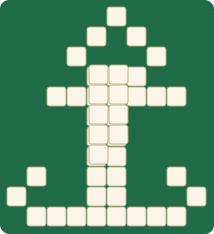
Medium · 46 tiles
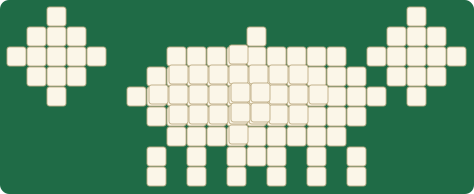
Hard · 122 tiles
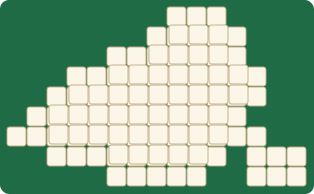
Hard · 126 tiles
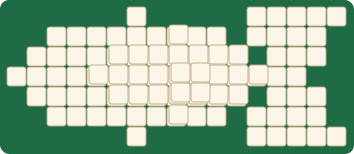
Medium · 110 tiles
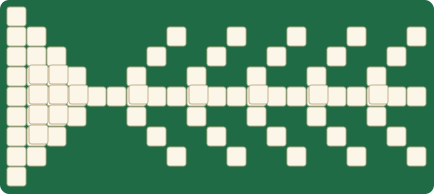
Hard · 84 tiles
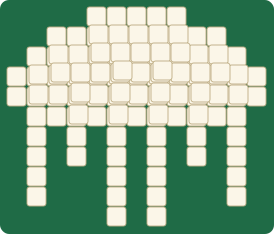
Hard · 144 tiles
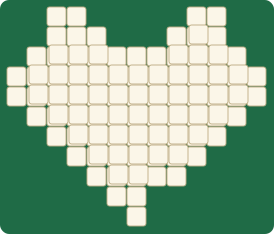
Hard · 134 tiles
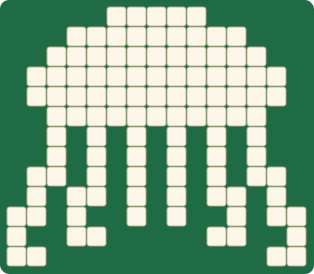
Expert · 108 tiles
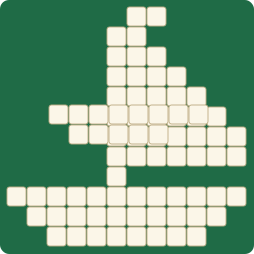
Hard · 80 tiles
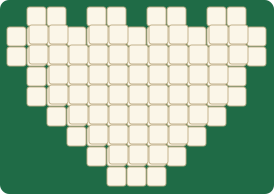
Medium · 132 tiles
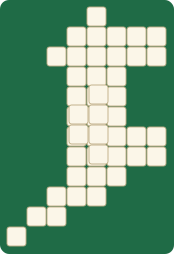
Hard · 46 tiles
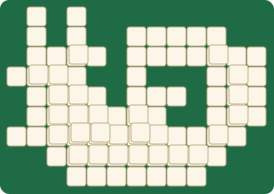
Medium · 106 tiles
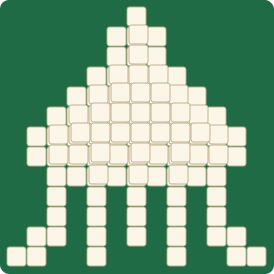
Hard · 138 tiles
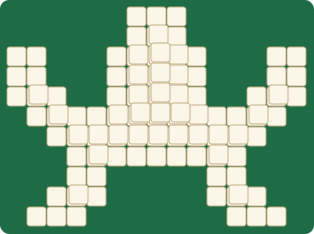
Medium · 122 tiles
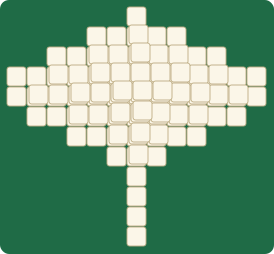
Medium · 124 tiles
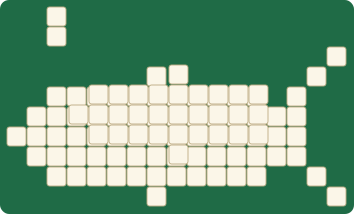
Hard · 104 tiles
Pyramid Mahjong Solitaire · Tower Mahjong · Twin Towers Mahjong · Bridge Mahjong · Cross Mahjong · Diamond Mahjong · Fortress Mahjong · Zodiac Mahjong · Animal Mahjong · Object Mahjong · Food Mahjong · Holiday Mahjong · Symbol Mahjong · Nature Mahjong · Geometric Mahjong · Easy Mahjong Solitaire · Hard Mahjong Solitaire · Christmas Mahjong
From the same team — more games, free to play online.