Hard Mahjong Solitaire
14 boards · free, no download.
14 boards · free, no download.
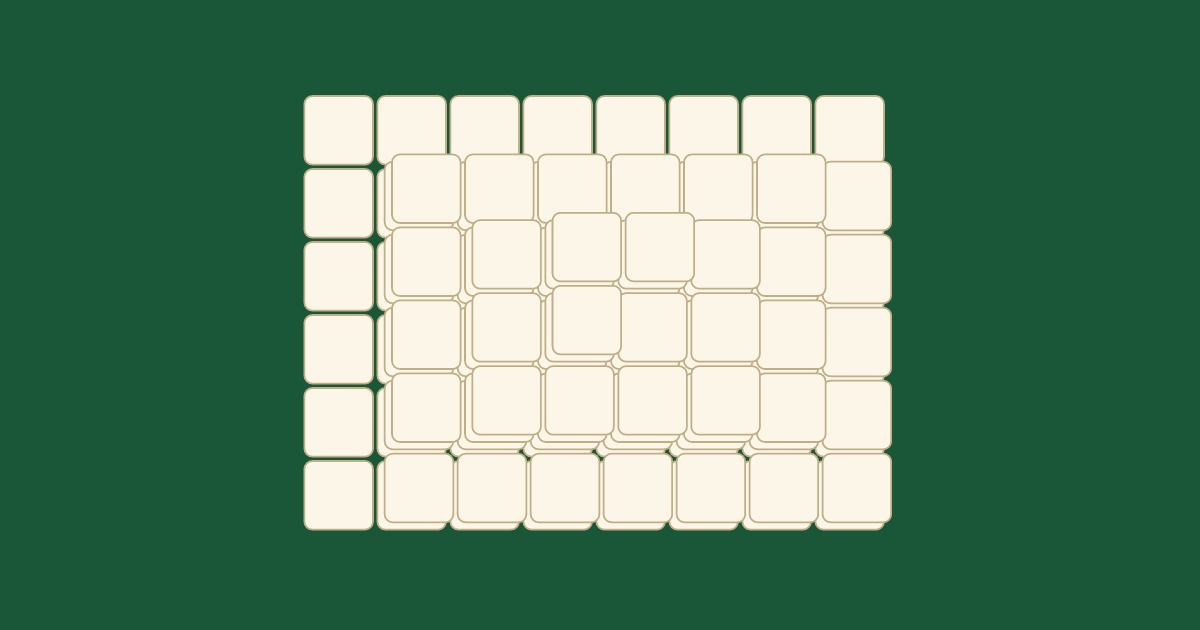
Play Hard Mahjong Solitaire free — instant in your browser, no download, no account. Hard Mahjong Solitaire is where the layouts stop being scenery and start being opponents. Every board gathered here is built to resist you: tall stacks that climb four, five, or six tiles into the air, dense floors packed edge to edge, and bridges that lock a dozen pieces behind a single keystone. The classic rules never change. You still match identical tiles that are free on a left or right edge with nothing stacked on top, and you still clear the whole board to win. What changes is how little room the shape leaves for a lazy click. On an easy turtle you can match almost anything you see and finish on instinct. On Mega Pyramid or Supreme Fortress, the same instinct empties the surface, strands the matching half of a pair under three other tiles, and quietly ends the game while pieces are still on the table. These boards reward the player who slows down and reads the structure before touching it.
If that sounds discouraging, it is meant to be inviting instead. Hard boards are the most satisfying ones to beat precisely because they make you earn it. A good hard layout feels less like a chore and more like a knot you are patiently working loose, where each correct move opens two or three new ones and you can feel the structure starting to give. The collection here spans towering pyramids, walled fortresses, woven mazes, and sprawling cosmic fields, so the difficulty arrives in genuinely different flavors rather than one wall repeated. Every board is guaranteed solvable from the opening deal, the Shuffle button always re-deals into another fully winnable arrangement, and matched flowers and seasons behave exactly as the rules promise. The challenge is real, but it is always fair.
Difficulty in Mahjong Solitaire is not about adding more tiles, though hard boards often do. A flat board with two hundred tiles can still be gentle if everything sits in a single layer where most pieces are free from the start. What actually makes a layout hard is depth and obstruction: how many tiles are pinned underneath others, and how long the chain of moves is before a buried tile becomes reachable. The boards in this hub are engineered for exactly that. They stack tiles high and bury the interesting matches deep, so the surface you see at the start hides most of the real game underneath it.
The second ingredient is what experienced players call the bottleneck. In an easy layout, blockages are local; if one pair is stuck, plenty of other pairs are free, so you rarely run out of moves. In a hard layout the structure funnels everything through a few critical tiles. A central keystone on Grand Cathedral, the load bearing spine of Twin Towers, or the locked core of Supreme Fortress can gate access to whole regions of the board. Remove the wrong supporting tile too early and you can paint yourself into a corner where pieces remain but no legal match exists. That risk of a dead end, even when tiles are still on the table, is the signature of a hard board.
The third ingredient is suit pressure. There are four copies of every numbered and honor tile, and on a hard board those four copies are frequently scattered across different heights and corners, so you cannot simply grab the two you see and move on. You have to think about where the other two are hiding and whether clearing this pair now will strand them later. Reading that distribution is the core skill these layouts are built to train.
Start every hard board by doing nothing. Before your first click, scan the whole structure top to bottom and find the tallest stacks, because those are where the deepest tiles are trapped. The general rule is to peel from the top and from the deep interior first, and to leave the wide, flat, easily reachable tiles on the outer edges for last. Surface tiles on the rim tend to stay free no matter what you do, so they are your safety net. The tiles you must hurry to free are the ones at the bottom of tall columns and in the center of dense floors, because every layer you remove above them is a move you cannot take back.
Treat matches as exchanges, not gifts. Each time two free tiles of the same kind appear, ask what each one is currently holding down before you clear them. If a free tile is the cap on a tall stack, matching it is pure profit because it exposes whatever sits below. If a free tile is sitting harmlessly on the ground with nothing above or beside it, there is rarely any rush, and clearing it may remove a useful guide piece or eliminate a future option you would rather keep open. The habit to build is matching the pairs that unlock the most beneath them, and deferring the pairs that unlock nothing.
Plan in branches, not single steps. Good play on Labyrinth or Constellation means looking three or four moves deep: if I take this pair, it frees those two tiles, and one of them matches a piece I can see across the board, which in turn opens the column I actually care about. When you find two different free copies of the same tile, you usually do not have to use both at once, and that choice is leverage; hold the option open and use the copy whose removal helps more. The single most useful safety habit is to keep a flexible pair in reserve for the endgame. Because every flower matches every flower and every season matches every season, an unmatched flower or season is a wildcard you can deploy at almost any moment, so resist clearing your last easy flower or season pair early. Saved for the final tiles, it can be the move that breaks an otherwise frozen position. And when you genuinely cannot find a legal match with tiles still on the board, the Shuffle button re deals the remaining pieces into a fresh, fully solvable arrangement, so a stall is a setback, never a loss.
The towers and pyramids are the purest test of vertical thinking. Mega Pyramid is an oversized stepped pyramid whose entire payload is stacked toward the center and capped at the apex, so almost nothing useful is free until you have carefully worked the top down. Twin Towers raises two tall parallel spires; the trap is that the towers feed each other, and clearing one side too aggressively can leave the other unsupported and full of unreachable tiles. Double Diamond sets two diamond shaped masses point to point, narrow in the middle and wide at the ends, which concentrates the hardest matches right at the pinched waist where the two halves meet.
The fortresses and temples are about walls and a defended core. Supreme Fortress and Dragon Fortress both build thick perimeter ramparts around a packed interior, so the early game is spent dismantling the outer walls just to reach the pieces that matter, and the danger is exhausting your free matches on the wall before you can get inside. Ancient Temple and Grand Cathedral are grand symmetrical structures with a tall central spine or nave; the keystone tiles down the middle gate huge sections of the board, and the whole layout can hinge on the order in which you unlock that central axis. Dragon Throne and Emperor are ceremonial, throne shaped boards where a raised central seat of tiles dominates and must be approached from the steps and arms before the high center yields.
The mazes and cosmic fields trade height for sprawl and interlock. Labyrinth and Spider Web are woven, looping shapes full of bridges and crossings where tiles brace one another sideways as well as from above, so a single removal can free or freeze a piece several tiles away along the strand. Galaxy and Constellation spread tiles into wide, scattered star fields and spiral arms; the difficulty there is less about deep digging and more about distance, since the four copies of a tile can sit in completely separate clusters that all have to stay reachable. Mandala is the most ornamental of the set, a radial symmetrical bloom of concentric rings that has to be unwound from the outside in, layer by layer, the way you would unwind an actual mandala. Across all of them the underlying rules are identical; only the geometry of the trap changes.
The names on these boards are not decoration for its own sake. They evoke the architecture of patience, of fortresses, cathedrals, thrones, temples, and the slow grandeur of the night sky, and that suits the unhurried, meditative pace that hard Mahjong rewards. A fortress wants to be besieged methodically. A cathedral wants to be entered through its great central nave. A constellation wants to be read like a map. The shape and the strategy reinforce each other, so the theme is doing real work: it tells you, at a glance, where the strong point of the board is and roughly how it expects to be taken apart.
Mahjong Solitaire itself carries a long heritage. It borrows the tile set of the centuries old four player game of Mahjong, the bamboo and circle and character suits, the dragons and winds, and the prized flowers and seasons, then reinvents them as a single player matching puzzle of skill and foresight. The hard boards lean hardest into that heritage of careful, considered play. Where a quick turtle is a pleasant few minutes, a board like Ancient Temple or Mandala can be a genuine sitting, the kind of puzzle you return to over a cup of tea and slowly chip away at.
The fun is in the structure giving way. Hard layouts are designed so that progress is uneven and earned in bursts. You can spend several minutes with the board feeling locked and stubborn, finding only forced or low value matches, and then one correct move down the central spine cascades into a run of openings and the whole thing seems to exhale. That rhythm of pressure and sudden release is what keeps experienced players coming back to the difficult boards long after the gentle ones have stopped surprising them. Beating Supreme Fortress or Mega Pyramid cleanly, with no shuffle, is a small craftsman's pleasure the easy boards simply cannot offer.
These are the deep end of the pool, and they are meant for players who already know the basic flow cold. If you are still learning that a tile must be free on a left or right edge with nothing on top before it can be matched, or you are not yet in the habit of clearing tall stacks before flat ones, you will have a far better time warming up on the easier turtle and pyramid layouts first and graduating here once matching feels automatic. There is no shame in that ramp; the hard boards are more enjoyable when the mechanics are second nature and your attention is free for planning.
For the right player, though, the difficulty is exactly the appeal, and the design works hard to keep it fair rather than cruel. Every board in this hub is guaranteed solvable from the deal, so a loss is always a planning mistake on your part and never an impossible arrangement dealt by the game. If you stall with tiles remaining, Shuffle re deals the leftovers into another fully winnable layout, which means you can experiment boldly, learn how a given shape wants to be opened, and try again without ever being permanently punished. That safety net is what lets a hard board be demanding and welcoming at the same time.
They suit a particular mood as much as a particular skill level. These boards reward the unhurried, the deliberate, the player who would rather think for thirty seconds than click on reflex. Many of the people who love them are not chasing a fast clear at all; they want a quiet, absorbing puzzle that asks for real attention and gives back a real sense of accomplishment. If that is you, work down from the tops, keep a flower or season in reserve for the final stretch, read the shape before you commit, and these tough boards will reliably give you the most rewarding Mahjong Solitaire sessions on the site.
Difficulty is partly a matter of which trap suits you least, but the boards that defeat the most players tend to be the tall, deeply layered ones like Mega Pyramid, Supreme Fortress, and Twin Towers, where so many tiles are buried that a single careless early match can strand a pair beyond reach. Mandala and Labyrinth are tough in a different way, demanding that you unwind a complex interlocked shape in the right order rather than just dig deep. A good approach is to try a few and notice whether you stumble more on vertical digging or on sideways interlock, then practice the type that gives you the most trouble. Whichever you pick, every one of them is fully solvable, so the hardest board is simply the one you have not yet learned to read.
That is the classic hard board mistake, and it almost always comes from clearing easy surface tiles too early. When you match the convenient free pairs on the outer edges first, you spend your safety net and leave the deep, awkward tiles for a moment when nothing is free to pair with them. The fix is to reverse your priorities: peel the tops off the tallest stacks and dig into dense centers first, and leave flat rim tiles for last because they usually stay free anyway. Before each match, check what each tile is holding down and prefer the pairs that expose the most underneath. If you do stall, press Shuffle to re deal the remaining tiles into a fresh solvable arrangement and keep going.
Every board in this collection is guaranteed solvable from the opening deal. There are no impossible arrangements; a complete solution always exists on the table when the board loads. If you reach a position with tiles left and no legal match available, that is the result of move order, not an unfair deal, and the Shuffle button will re deal the remaining pieces into another fully solvable layout so you can continue. In short, losing a hard board always means there was a better order you could have played, which is precisely what makes finishing one feel earned.
Flowers and seasons are the bonus tiles borrowed from traditional Mahjong, and they follow a special matching rule: any flower matches any other flower, and any season matches any other season, rather than needing an identical twin. That makes a free flower or season effectively a wildcard, and on hard boards that flexibility is gold. Because they pair so freely, they are the ideal tiles to hold in reserve for the endgame, when the remaining ordinary tiles can be hard to line up. Try not to burn your last easy flower or season pair early; saved for the final few moves, it can be the wildcard that breaks open a position that otherwise looks frozen.
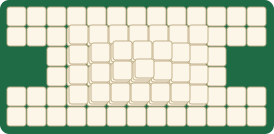
Master · 120 tiles
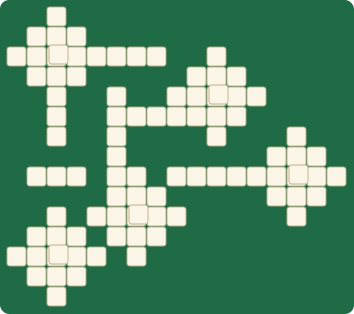
Master · 90 tiles
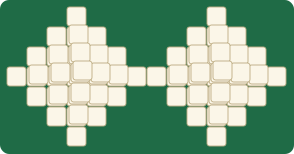
Master · 88 tiles
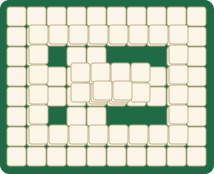
Master · 110 tiles
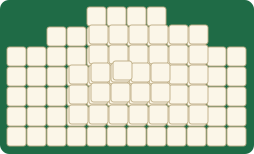
Master · 114 tiles
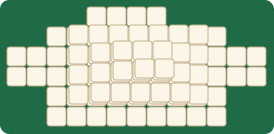
Master · 108 tiles
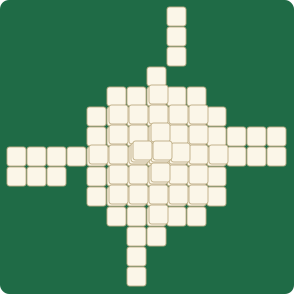
Master · 102 tiles
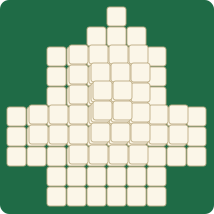
Master · 112 tiles
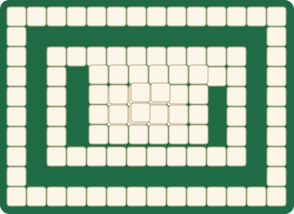
Master · 108 tiles
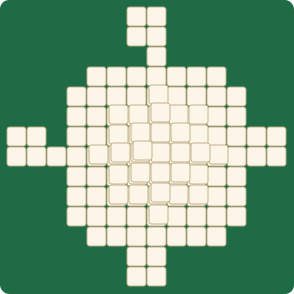
Master · 138 tiles
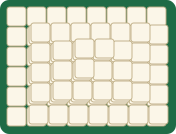
Master · 122 tiles
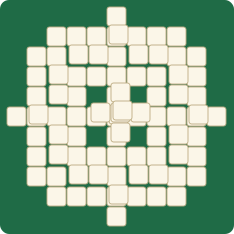
Master · 88 tiles
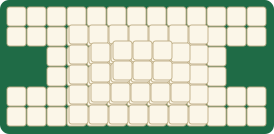
Master · 126 tiles
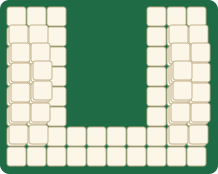
Master · 100 tiles
Pyramid Mahjong Solitaire · Tower Mahjong · Twin Towers Mahjong · Bridge Mahjong · Cross Mahjong · Diamond Mahjong · Fortress Mahjong · Zodiac Mahjong · Animal Mahjong · Object Mahjong · Food Mahjong · Holiday Mahjong · Symbol Mahjong · Nature Mahjong · Geometric Mahjong · Easy Mahjong Solitaire · Christmas Mahjong · Ocean Mahjong
From the same team — more games, free to play online.