Bridge Mahjong
41 boards · free, no download.
41 boards · free, no download.
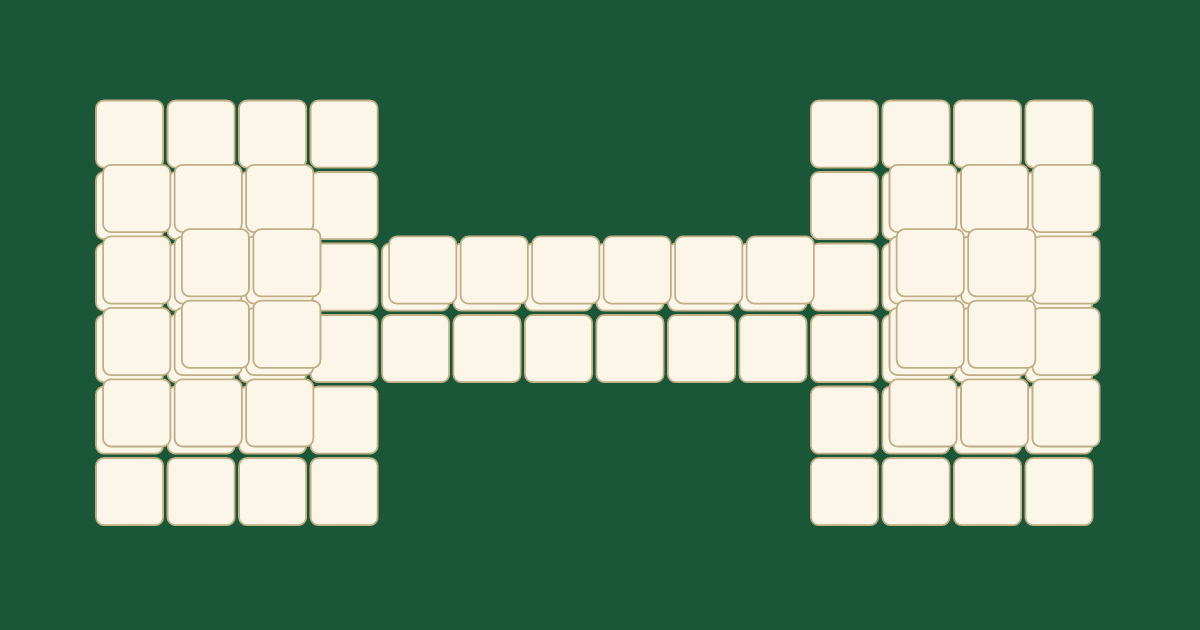
Play Bridge Mahjong free — instant in your browser, no download or sign-up needed. Bridge Mahjong is a family of Mahjong Solitaire boards built around one simple, satisfying silhouette: two raised stacks of tiles standing apart like stone piers, joined across the middle by a long, low deck that arcs between them like a span. Every board in this collection plays on that same architectural idea, the way a real bridge needs both its towers and the roadway that ties them together. You are still doing the one thing Mahjong Solitaire always asks of you, matching identical tiles two at a time and clearing the whole board, but the bridge shape changes the rhythm of how those matches open up. The span across the center starts wide open and generous, while the piers at either end keep their tiles guarded until you have done some work.
The appeal is that a bridge layout looks impressive but plays gently. Because the central deck is laid out mostly in the open, a large share of tiles are free to select from your very first move, so you are rarely stuck staring at a board with nowhere to begin. That immediate sense of progress is exactly what makes Bridge such a welcoming place to learn, and why it stays comfortable on an afternoon when you want a game that flows rather than fights you. At the same time the stacked end-piers add just enough structure to keep things interesting. They hold tiles in reserve, reward a bit of planning, and give the more confident player something to think about. This page gathers every board in the Bridge family in one place, from the plain original to ornate variants like Royal Bridge, Jade Bridge, Crystal Bridge, and the heftier Double Bridge and Ancient Bridge.
In Mahjong Solitaire, the shape of a board is everything. The rules never change: you remove tiles in matching pairs, and a tile can only be taken when it is free, meaning nothing sits on top of it and at least one of its left or right sides is open. What makes one board a five-minute breeze and another a twenty-minute puzzle is purely how the designer chose to stack and arrange the tiles. A Bridge layout arranges them into the form its name promises. Picture the deck strung out horizontally across the playfield, a long ribbon of tiles forming the roadway, and then at each end that ribbon climbs into a compact tower of stacked layers, the supporting piers that anchor the whole span.
That central span is the heart of why Bridge feels different from compact pyramid or fortress shapes. The roadway is mostly one or two tiles deep and laid out in a line, which means tiles there tend to have open sides and few or no tiles resting on them. Free tiles are everywhere along it. The piers are the opposite. They are where the height lives, several layers tall, with tiles capping and bracing one another, so those positions stay locked until you peel them down from the top and the outside. You can think of the board as two zones with two personalities: an easy, breezy middle and two patient, stacked ends. Reading that contrast on sight is most of what you need to play a Bridge board well.
Because the silhouette is so recognizable, the Bridge family also reads instantly even before you make a move. You glance at the screen and you already know the plan in broad strokes: the long part is your opening, the tall parts are your endgame. Very few Mahjong shapes telegraph their strategy that clearly, which is part of what makes this collection such a friendly entry point and such a relaxing one to return to.
Start in the middle and work outward. The single most reliable approach on any Bridge board is to open along the long central deck, because those tiles are nearly all free from the very first move and clearing them costs you almost nothing in flexibility. Sweeping the span does double duty: it racks up easy matches, and it exposes the inner faces of the two piers so that the stacked towers finally start to come apart. Think of the roadway as the thing you must thin out before the supports will give up their tiles. If you knock the span down quickly and carelessly, that is usually fine here, but the disciplined habit is to keep an eye on what each removal frees up at the pier ends.
Save the stacked supports for once the span is thinned. The piers are where a winnable Bridge board can still go wrong, because tiles buried inside a tower can only come out in a particular order, and a careless early grab can leave a needed match trapped under its own partner. A useful rule of thumb is to resist diving into a pier just because a tempting tile is sitting on top of it. Ask first whether taking it actually opens something underneath you want, or whether it simply uncovers more of the same problem. The towers reward patience, so spend your early, plentiful free moves on the roadway and let the piers be the puzzle you solve last.
Watch the two ends against each other. A recurring pattern on Bridge boards is a matching pair split across opposite piers, one tile on the left tower and its twin on the right. When you spot that, treat it as a small project: clear toward both of them in parallel so that neither sits exposed and unmatched while you scramble for the other. More generally, before you commit to any match, glance at all four faces of the board and ask where the other two copies of that tile are. Mahjong Solitaire tiles almost always come in sets of four, and a tile that looks safe to take can be the only key to a tile you will need later.
Two safety nets make all of this forgiving. Every Bridge board on this site is built to be fully solvable, so a clean win always exists from the starting deal, which means a loss is a sign to slow down and look harder rather than evidence the board was rigged against you. And when you do paint yourself into a corner, the Shuffle option re-deals the remaining tiles into a fresh, still-solvable arrangement, so a stuck position is never the end of the road. Use Undo to walk back a move you regret, and use Hints sparingly when you genuinely cannot find a pair, but try to lean on reading the board first, because that is where the real enjoyment of these layouts lives.
The collection runs from the bare original to elaborate cousins, and the variety is mostly in proportion and trim rather than in any change to the rules. The plain Bridge is the reference point: a clean span between two modest piers, the most open and forgiving member, and the one most people should meet first. From there the themed variants keep the same bones but dress them up and adjust the balance, so each one feels like a fresh board while remaining unmistakably a bridge.
Royal Bridge leans into grandeur, a more stately span suited to players who want the silhouette to feel ceremonial. The color-named entries are a small palette of moods: Cobalt Bridge in deep blue, Jade Bridge in cool green, Amber Bridge in warm gold, Crimson Bridge in rich red, Crystal Bridge with a clear, glassy feel, Velvet Bridge with a soft, plush tone, Lunar Bridge under a pale moonlit cast. Each shares the central-deck-and-piers logic, so the strategy you learn on one carries straight over to the next, and you can collect the set without ever relearning how to play.
Several designs come in numbered tiers for players who want a little more board. Velvet Bridge II, Amber Bridge II, Cobalt Bridge II, Cobalt Bridge III, and Jade Bridge II are larger or more layered takes on their originals, typically with taller piers or a longer span that stretches the same idea into a meatier solve. Then there are the two standouts at the heavy end. Double Bridge does exactly what it sounds like, pairing up the bridge motif so you are managing two spans and their supports at once, which roughly doubles the planning. Ancient Bridge gives the shape a weathered, time-worn character and tends to play as one of the more substantial puzzles in the family. Whether you want a quick, breezy round or a longer sit-down challenge, there is a Bridge board pitched at it.
Bridges are one of humanity's oldest and most universally loved structures, and that is no accident in a tile game. A bridge is the rare piece of engineering that is also a symbol: of crossing over, of connecting two sides, of a path made where there was a gap. Rendering that in stacked tiles taps into something genuinely pleasing, because you are not just clearing an abstract grid, you are dismantling a recognizable little monument piece by piece. Many cultures have prized their bridges as landmarks, from arched stone spans to grand ceremonial crossings, and the variants here borrow that sense of occasion. Royal Bridge and Ancient Bridge in particular play up the idea of a storied, important structure rather than a plain footbridge.
The shape is also fun in a purely tactile, puzzle way. Because the board has a clear front-to-back story, span first then piers, clearing it feels like a small narrative with a beginning, a middle, and an end, rather than a flat grind through a pile. There is real satisfaction in watching the long roadway dissolve under your matches and then seeing the two towers finally start to topple inward now that nothing connects them. The deep blues of Cobalt, the greens of Jade, the gold of Amber, and the moonlit pale of Lunar all give that same arc a different atmosphere, so the family stays visually fresh even though the underlying move is always the same calm act of matching pairs.
And there is a quiet thematic wink in how these boards play. A real bridge stands because its piers hold the span, and these puzzles come apart only when you reverse that: thin the span so the piers lose their reason to stand. Clearing a Bridge board is, in a small way, an act of careful unbuilding, and doing it cleanly feels like the structure was always meant to be taken down in that order. That harmony between the look of the thing and the way it solves is what keeps people coming back to the shape.
As a family, Bridge sits toward the gentler, more relaxing end of Mahjong Solitaire, and that is by design. The wide-open central deck means there are usually plenty of legal moves on the screen at any moment, which is the main thing that keeps a board feeling easy and stress-free rather than tense. You are seldom hunting desperately for a single move, and that steady supply of options is precisely why the shape is such a forgiving teacher of the basics: how to scan for free tiles, how to read what a removal will uncover, how to pace yourself across a board instead of grabbing the first match you see.
That makes the plain Bridge an excellent first stop for newer players, for anyone returning to Mahjong after a long break, and for relaxed players who simply want a pleasant game that does not punish them. It is also well suited to playing while half your attention is elsewhere, the kind of low-key round you can dip in and out of. The forgiving nature does not mean the wins are hollow, though. Clearing the piers in the right order still takes a little thought, and the satisfaction of dismantling that final tower is real.
When you want more bite, the family scales up to meet you. The numbered tiers and the bigger structures, especially Double Bridge with its two spans to juggle and Ancient Bridge with its weightier build, ask for genuine planning and reward players who like to think a few moves ahead. So the Bridge collection works for a wide range of moods and skill levels under one consistent, comfortable shape: open and breezy when you want to unwind, layered and deliberate when you want a real puzzle, and always solvable so that the only thing standing between you and a finished board is finding the path.
Yes, it is one of the friendliest. The long central deck leaves a large number of tiles free from your very first move, so you always have somewhere to start and rarely feel stuck early on. That makes the plain Bridge a great place to learn solitaire pacing and how to read which tiles a removal will free up. Once you are comfortable, the bigger variants like Double Bridge and Ancient Bridge offer a step up in challenge using the exact same rules.
Open across the long central span. Those tiles are nearly all free and clearing them costs you little flexibility, while it exposes the inner faces of the two end-piers so the stacked towers can finally come apart. Hold off on diving into a pier just because a tile sits temptingly on top of it. Thin out the span first, and save the supports for the endgame, watching for matching tiles that sit on the two opposite piers so you can clear toward both at once.
Every Bridge board on this site is built to be fully solvable, so a clean win always exists from the starting deal. If you get stuck, it means a tile was taken in an unhelpful order rather than that the board was impossible. The Shuffle option re-deals the remaining tiles into a new arrangement that is also guaranteed solvable, and Undo lets you step back a move you regret, so you are never truly trapped.
The rules are identical to any Mahjong Solitaire game, matching free tiles two at a time until the board is clear. What sets Bridge apart is its shape: a long, mostly open horizontal deck forming the roadway, with tall stacked piers at each end. That split gives it two distinct zones, an easy breezy middle and two patient stacked ends, so the natural rhythm is to sweep the span first and dismantle the towers last. Compact pyramid or fortress shapes pack the height more evenly and tend to play tighter from the start.
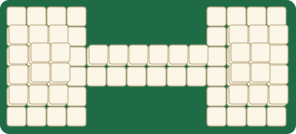
Hard · 98 tiles
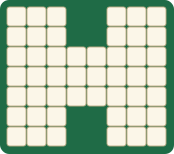
Medium · 48 tiles
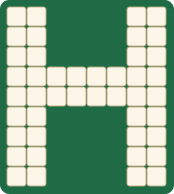
Medium · 44 tiles
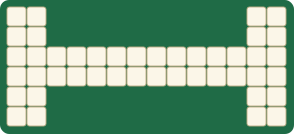
Medium · 44 tiles
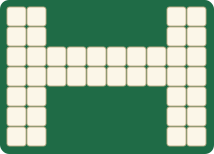
Easy · 40 tiles
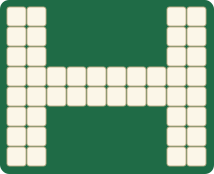
Medium · 44 tiles
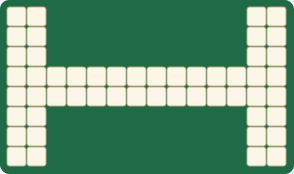
Medium · 52 tiles
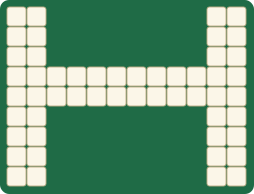
Medium · 52 tiles
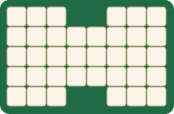
Easy · 36 tiles
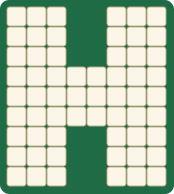
Medium · 60 tiles
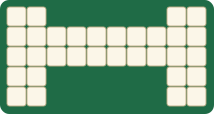
Easy · 32 tiles
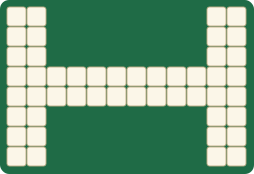
Medium · 48 tiles
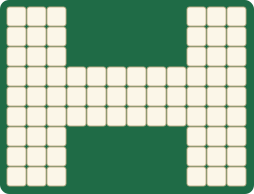
Medium · 72 tiles
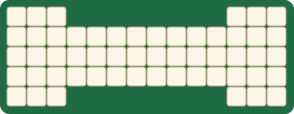
Medium · 54 tiles
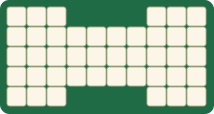
Easy · 42 tiles
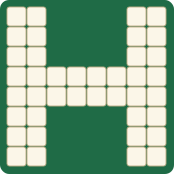
Easy · 40 tiles
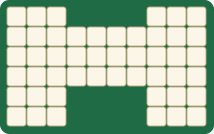
Medium · 48 tiles
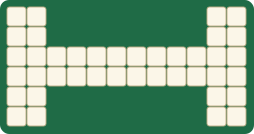
Easy · 40 tiles
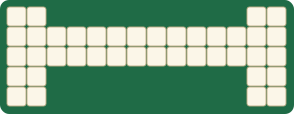
Easy · 40 tiles
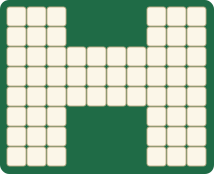
Medium · 60 tiles
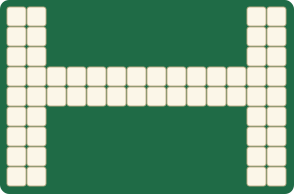
Medium · 56 tiles
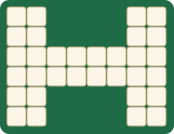
Easy · 32 tiles
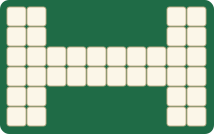
Easy · 36 tiles
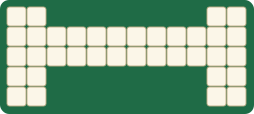
Easy · 36 tiles
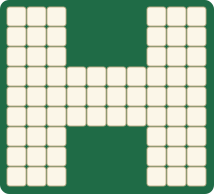
Medium · 66 tiles
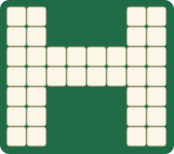
Easy · 36 tiles
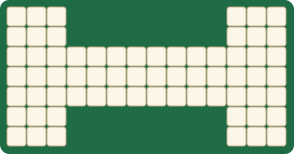
Medium · 66 tiles
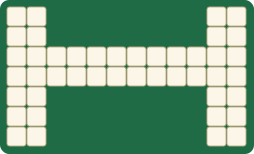
Medium · 44 tiles
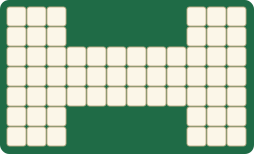
Medium · 60 tiles
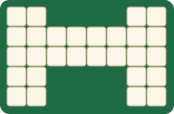
Easy · 28 tiles
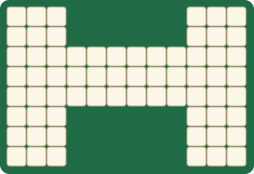
Medium · 66 tiles
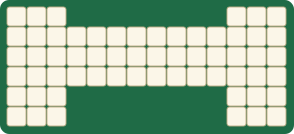
Medium · 60 tiles
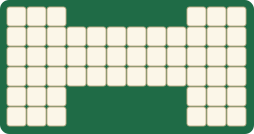
Medium · 54 tiles
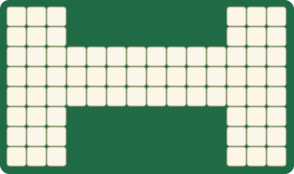
Medium · 72 tiles
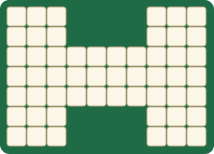
Medium · 54 tiles
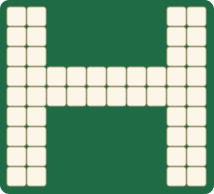
Medium · 48 tiles
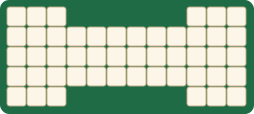
Medium · 48 tiles
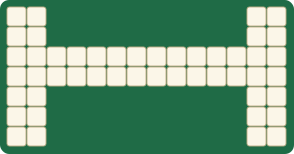
Medium · 48 tiles
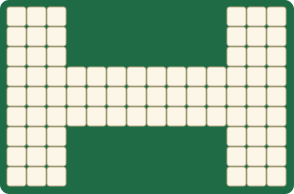
Hard · 78 tiles
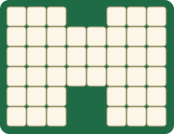
Easy · 42 tiles
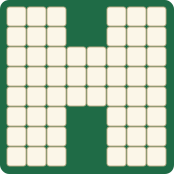
Medium · 54 tiles
Pyramid Mahjong Solitaire · Tower Mahjong · Twin Towers Mahjong · Cross Mahjong · Diamond Mahjong · Fortress Mahjong · Zodiac Mahjong · Animal Mahjong · Object Mahjong · Food Mahjong · Holiday Mahjong · Symbol Mahjong · Nature Mahjong · Geometric Mahjong · Easy Mahjong Solitaire · Hard Mahjong Solitaire · Christmas Mahjong · Ocean Mahjong
From the same team — more games, free to play online.