Christmas Mahjong
5 boards · free, no download.
5 boards · free, no download.
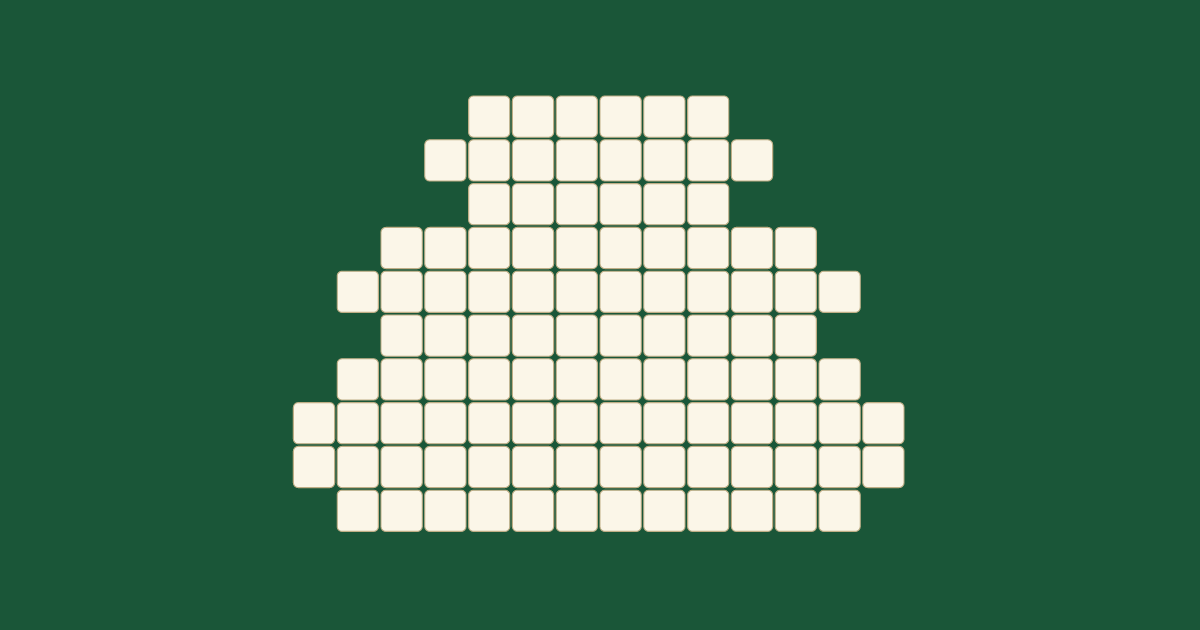
Play Christmas Mahjong free online — instant in your browser, no download, no sign-up. Christmas Mahjong is a small, snug collection of Mahjong Solitaire boards built entirely out of the season's icons. Rather than the anonymous turtle mound most people picture when they hear Mahjong, every layout here is stacked into the outline of something from around the house in late December: a round three-tier Snowman in a scarf, a slumped Santa Hat with a pompom on its tip, a Christmas Stocking with a fuzzy cuff and a hanging toe, a circular Wreath with a bow at the bottom, and a Gift Box tied off with ribbon. You play the same dependable matching game you already know, removing pairs of free tiles until the table is bare, but the silhouette you are slowly taking apart actually means something, and that bit of theme turns a few idle minutes into proper holiday comfort.
The appeal is exactly the kind of calm these boards are built for. There is no clock ticking down, no score draining while you think, and no level you must beat before trying the next one. Every Christmas Mahjong board is solvable from the moment it loads, the Shuffle button always re-deals whatever tiles remain into another arrangement you can still finish, and the bonus flower and season tiles are chosen to suit the wintry mood so the whole table feels of a piece. Whether you want a snowman to clear with your morning coffee, a stocking to unwind with on a dark evening, or a wreath to keep a grandchild busy for a turn, the promise is the same: a gentle, beatable puzzle in its Christmas best, ready in July just as readily as in December.
At its heart this is ordinary Mahjong Solitaire, the matching game where a pile of tiles is stacked into overlapping layers and you clear it two at a time. A tile is playable, what the game calls free, only when nothing is resting on top of it and at least one of its long sides, left or right, is open so it can slide out. Tap two free tiles that show the same face and the pair disappears together. Empty the whole board and you win. The faces are the traditional set: the three numbered suits of Circles, Bamboo, and Characters running one through nine, the Wind and Dragon honor tiles, and the two bonus groups of Flowers and Seasons, which are the one spot where the matching rule loosens its grip.
What makes the Christmas version its own thing is the floor plan rather than the rulebook. A standard board heaps its tiles into a tidy symmetrical hill; a Christmas Mahjong board arranges those same tiles to draw a recognizable picture. The puffy curve of a snowman's belly, the bent point of a Santa hat, the long leg of a stocking, the perfect ring of a wreath. The total number of tiles stays even so the board always clears cleanly in pairs, but where each piece sits, how it overlaps its neighbours, and which tiles it pins underneath are all dictated by the shape rather than by some neat geometric formula. That is the whole idea of the category: the familiar game you already play, redrawn as the things you decorate the house with.
Because the outlines are so easy to name, these boards are unusually kind to read. You do not have to study a blank slab and guess where to begin. You look at a wreath and already sense, correctly, that the bow at the bottom and the loose rim of the ring will come apart before the thick body does. That readability is half the charm, and it sets a Christmas board apart from the more abstract dragon, pyramid, or fortress layouts where the geometry gives you nothing to hold on to.
The most useful habit on any of these boards is to read the silhouette before you touch a single tile, and to look first for the topper. Holiday shapes almost always have a small detail perched above the main body, balanced on a thin stack with very little holding it down, which is precisely why it tends to come apart first. On the Snowman it is the carrot nose, the coal buttons, and the brim of its little hat; on the Santa Hat the pompom at the tip; on the Stocking the soft cuff; on the Wreath the bow at the bottom and a star at the crown; on the Gift Box the bow and trailing ribbon. Peel that detail away first, then work steadily down and outward into the bulkier body where the real depth of the stack is waiting.
After that opening, the general strategy that wins any game of Mahjong Solitaire still applies, only bent to the picture in front of you. Always favour a match that frees more tiles over one that frees nothing, and be careful about clearing both copies of a face early when the third and fourth are still buried, because that is the classic way to strand yourself with two locked tiles that have no surviving partner. The wide middle, the snowman's belly, the heel of the stocking, the centre of the gift, is where tiles stack deepest, so open it from the edges in a controlled way rather than digging one narrow shaft straight down. The long flexible runs, the outer ring of the wreath, the leg of the stocking, the slumped flap of the hat, are your most forgiving tiles, so keep a few in reserve as release valves for the moment the centre jams up.
Two short rules cover the bonus tiles, and they make life easier. Any Flower pairs with any other Flower, and any Season with any other Season, so among those eight pieces you never hunt for an exact twin, only for another member of the same group. Treat them as opportunistic clears: snap them up when they release something useful, but you rarely need to chase them. And if you ever genuinely run out of legal moves, the Shuffle button is not a penalty or a gimmick. It re-deals the tiles still on the table into a fresh arrangement that is once again guaranteed solvable, so a stuck board is always recoverable rather than a reason to start over. With no timer hurrying you along, the patient read almost always beats the quick grab, and that is what turns a board you scrape through into one you finish comfortably.
This hub keeps its focus tight on the heart of the season, so the lineup is a handful of well-loved December shapes rather than a whole calendar of holidays. The Snowman is the friendliest face of the set, three rounded tiers stacked into a head and body, dressed up with a hat, a scarf, coal buttons, and a carrot nose, which gives it plenty of small toppers to pick off before you reach the deep belly in the middle. The Santa Hat is more compact and breezier, a slumped cone of tiles narrowing to a single bright pompom, with a wide soft brim along the bottom that opens up quickly and a thinner peak that funnels you into a tighter finish.
The Christmas Stocking hangs long and tall, a fuzzy cuff above a stretched leg dropping to a rounded heel and toe, so it plays as a more vertical, column-leaning puzzle where the order you work down the leg matters more than on a squat board. The Wreath is the most distinctive shape of the group, a full ring with a hollow centre and a bow at the base, so you work a loop from both the inside and outside edge at once rather than digging into a solid mass, a genuinely different rhythm. The Gift Box rounds out the core set, a chunky square crossed by ribbon and topped with a bow, deeply stacked in the middle and satisfying to dismantle from its decorations inward.
Because the shapes run from squat and wide, like the gift, to tall and narrow, like the stocking, the feel shifts noticeably from board to board even though the rules never budge, and the small, curated size of the hub means each one feels like its own deliberate little puzzle rather than one of a hundred near-identical variations.
A good part of the enjoyment here is purely the look of the thing. A standard Mahjong hill is handsome but says nothing; a board shaped like a snowman in a scarf or a stocking waiting to be filled has personality before you have made a single move, and watching it slowly vanish, tile by tile, is its own quiet reward. There is a gentle story in every clear, too. As you take a snowman apart you lift off its hat, then its buttons, then its head, until the friendly figure is gone; as you empty a gift you untie the bow before the box disappears. The board narrates its own undoing, and that tidy beginning, middle, and end gives a short session a satisfying shape.
The shapes also carry the warmth of the season they borrow from, which is a big reason these boards land so well. A wreath, a stocking, and a snowman each summon the whole feeling of Christmas in a single outline, the smell of the tree, the lights in the window, the morning the presents appear. Mahjong itself is an old tile game with centuries of history, and people have long arranged its pieces into pictures and lucky symbols for festivals and family gatherings simply because the tiles invite it. Dressing the solitaire form in these Christmas icons marries something genuinely ancient to something warmly modern. You are not only clearing tiles, you are spending a few unhurried minutes inside the holiday, and you can do that on a grey afternoon in spring just as easily as on Christmas Eve.
There is a collector's pleasure to having these gathered in one place, too. Once you have cleared the snowman you naturally fancy the stocking, then the wreath, then the gift, and the variety keeps the same simple game feeling fresh across many sittings without ever asking you to learn a new rulebook. It makes a lovely seasonal ritual, a board or two with a hot drink while the December evenings draw in, and that blend of comfort and gentle variety is a large part of why people return year after year.
Christmas Mahjong sits firmly at the relaxed, welcoming end of the puzzle spectrum, which is the point. Nothing here is racing you, nothing punishes a slow or thoughtful move, and there is no locked door to get through before you can play the board you actually want. Every layout is solvable from its opening deal, every Shuffle keeps it solvable, and if a board ever feels tangled you can simply reshuffle or start a fresh deal. That makes the whole category genuinely friendly to older players, to anyone coming back to Mahjong after years away, and to complete newcomers who would rather learn the matching rules on a pleasant, recognisable board than on a featureless mound.
Difficulty does vary across the set, and the shape is a fair guide. The Santa Hat is the gentlest, a smaller board with a wide easy brim and a shallow stack, ideal for a five-minute break or a first ever attempt. The Snowman and the Gift Box hold more tiles and pack a deeper, more overlapping centre, so they reward a little patience and the steady habits above. The Wreath asks for the most care, because working a hollow ring from both edges is different thinking from emptying a solid body, while the long Stocking puts the emphasis on the order you come down the leg. None of them is designed to defeat you, though. A confident player can clear most in one calm sitting, and someone playing purely to switch off can lean on Shuffle as often as they like and still always reach a clean, empty board. Whatever mood you bring, there is a Christmas board here to match.
Yes, every one of them. Each board in this hub is generated and checked so that the opening deal can always be cleared right down to the final pair, and if you ever run out of legal moves the Shuffle button re-deals the remaining tiles into another arrangement that is still guaranteed solvable. You can never be dealt a Christmas board that is impossible to finish, so a stuck position is always a temporary snag rather than a dead end. If you suspect an early move locked things up, press Shuffle and carry on.
Begin with the Santa Hat. It is the smallest and shallowest of the Christmas shapes, with a wide brim that opens up almost immediately, so it is an easy place to learn the one rule that matters: you can only pick a tile with nothing on top of it and at least one open side, left or right, and you win by removing matching pairs of those free tiles. Start by taking off the topper, then work down into the body, always preferring matches that free more tiles, and lean on Shuffle whenever you get stuck. Once that clicks, the Snowman, Stocking, Wreath, and Gift Box are a natural next step.
They are the one place the matching rule relaxes in your favour. Any Flower tile pairs with any other Flower, and any Season with any other Season, so you never need an identical twin for those eight bonus pieces, only another member of the same group. On Christmas Mahjong boards the flowers and seasons are also chosen to suit the wintry, festive mood, so the bonus tiles feel like part of the theme rather than an afterthought. Grab them when they free something useful, but you rarely need to go out of your way to chase them down.
Not at all. The boards are organised around the season purely for the warm, cosy flavour of the shapes, but every one is available the moment you want it. If a snowman sounds relaxing in the middle of summer or a wreath catches your eye in spring, play it. Plenty of people pick a board by its look or by the challenge they are in the mood for rather than by the calendar, and nothing restricts a Christmas board to its time of year. It is there whenever you fancy a calm, festive puzzle.
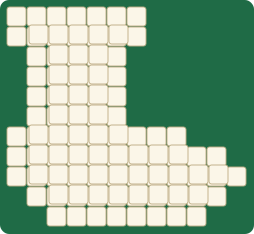
Hard · 132 tiles
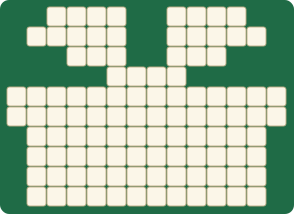
Hard · 104 tiles
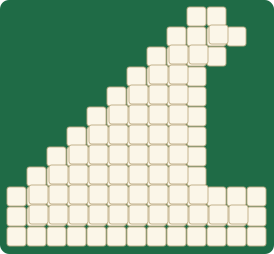
Medium · 138 tiles
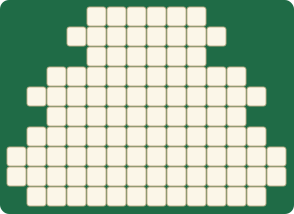
Medium · 104 tiles
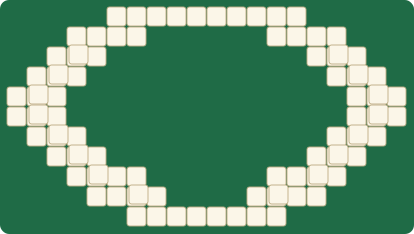
Hard · 94 tiles
Pyramid Mahjong Solitaire · Tower Mahjong · Twin Towers Mahjong · Bridge Mahjong · Cross Mahjong · Diamond Mahjong · Fortress Mahjong · Zodiac Mahjong · Animal Mahjong · Object Mahjong · Food Mahjong · Holiday Mahjong · Symbol Mahjong · Nature Mahjong · Geometric Mahjong · Easy Mahjong Solitaire · Hard Mahjong Solitaire · Ocean Mahjong
From the same team — more games, free to play online.