Geometric Mahjong
28 boards · free, no download.
28 boards · free, no download.
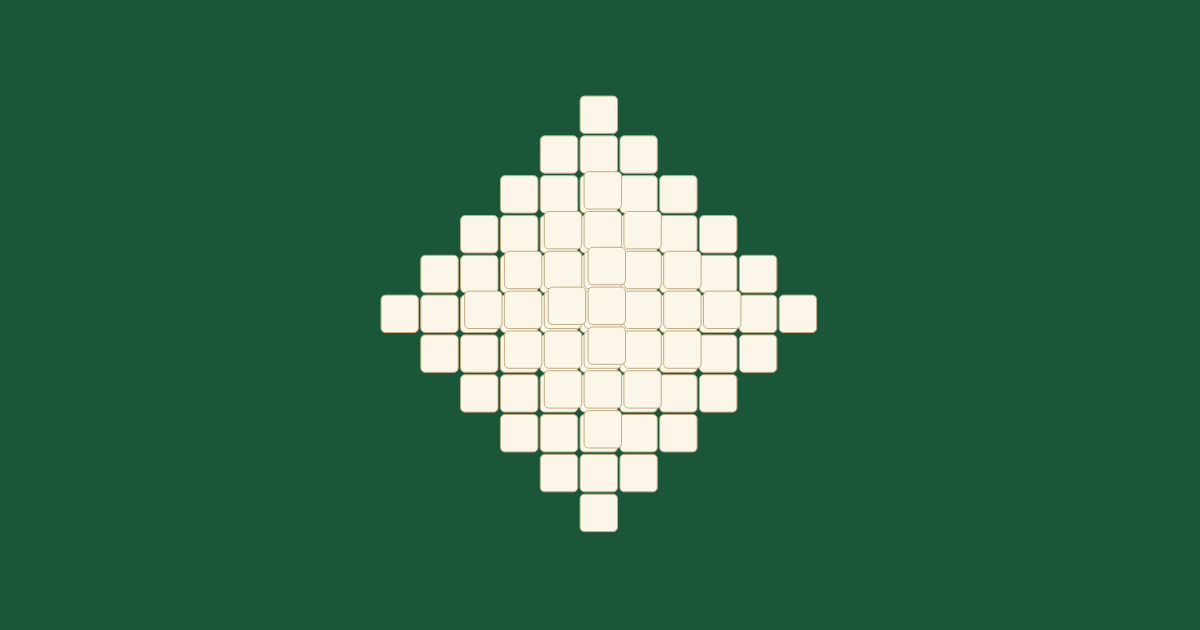
Play Geometric Mahjong free online — every board starts instantly in your browser, no download needed. Geometric Mahjong is the corner of the matching world where the tiles stop pretending to be dragons or temples and instead snap into pure shape: a diamond standing on its point, a six-point star, a ring of stones with a hole at the heart, a heart you could send on a card. Instead of a sprawling, organic pile, every board here is built to a plan. Tiles are placed along clean edges and balanced halves so the finished layout reads as a single recognizable form before you have removed a single pair. If you have ever liked the satisfaction of a tidy desk or a well-set table, these boards are aimed squarely at you.
The appeal is partly that order and partly the puzzle hiding inside it. A symmetrical shape looks calm, but it plays like a balancing act: the left arm of a star mirrors the right, the top of an hourglass answers the bottom, and the way you eat into one side quietly decides whether the opposite side stays reachable. Every layout in this collection is fully solvable from the deal, so the elegance is never a trap. Underneath the clean silhouette, each board is just standard Mahjong Solitaire, the timeless game of clearing a pile two tiles at a time, dressed in geometry instead of jungle.
Mahjong Solitaire, the single-player matching game, is normally played on a loose, mounded pile of tiles, the famous Turtle being the best-known example. Geometric Mahjong keeps every rule of that game and changes only one thing: the floor plan. Here the same 144 tiles are arranged so the overall outline forms a deliberate shape. A diamond board tapers to points at top and bottom and bulges in the middle. A hexagon fills out six straight sides. A spiral curls inward like a coiled rope. A cross plants four equal arms around a center. The tile art, the suits, the bamboos and circles and characters, the winds and dragons, the flowers and seasons, all stay exactly as you know them.
The matching itself never changes. You clear the board by removing identical pairs of tiles, and a tile can only be taken when it is free, meaning it has no tile stacked on top of it and at least one of its left or right long edges is open. Pull two free matches off, and the tiles beneath or beside them may open up in turn. The geometry simply decides which tiles start free, where the early openings sit, and how the board collapses as you play. That is why the same handful of rules can feel so different on a star than it does on a turtle.
One detail worth stating plainly: a clean shape on screen does not mean a flat, single-layer board. Most of these layouts stack tiles two or three deep in places to give the form some height and body, so a ring or a crown has a raised rim and a sunken middle. The silhouette you see from above is the shape; the third dimension is what makes the puzzle. Reading both at once, the outline and the depth, is the small skill that geometric boards quietly teach.
The first move on any geometric board is to look, not to click. Spend a few seconds tracing the outline and finding the symmetry. Most of these shapes are mirror-balanced left to right, top to bottom, or both, and that symmetry is the key to the whole strategy. When a board is symmetrical, the tiles open up in matching positions on opposite sides. The smart play is to clear opposite sides in step, taking a pair from the left arm and then the answering pair from the right, so the structure comes down evenly and the center stays reachable from every direction. Gut your way down one side alone and you can wall yourself off from the other, leaving its matches locked behind tiles you can no longer reach.
The center is the prize and the danger on most shaped layouts. Stars, rings, crowns and pinwheels all tend to pile their height in the middle and feed it from the edges, which means the heart of the board is the last thing to come free. Resist the urge to dig straight for the middle early; you usually cannot reach it yet, and trying wastes the free matches you do have. Instead, peel the outer edges and let the openings work their way inward. On a ring or an octagon, the rim is your starting buffet and the inner courtyard is dessert. On a spiral or a zigzag, follow the path the shape draws for you, working from the open tail toward the buried core.
Three habits carry across every board in this hub. First, when the same tile shows up more than twice, watch your pairings: matching the wrong two can strand the other two in spots you cannot open later. Second, when several legal moves are on offer, prefer the one that frees the most new tiles or unblocks a long-stuck region over the one that merely tidies an already-open edge. Third, treat the flowers and seasons as the gift they are. Any flower matches any other flower and any season matches any other season, so those eight tiles are flexible matches you can use to break a logjam, but spend them with intent rather than reflex. And if you genuinely run dry, every board offers a Shuffle that re-deals the remaining tiles into a fresh solvable arrangement, so a stall is a reset, never a dead end.
The variety in this collection is the whole point, and it runs from the strict and architectural to the playful and pictorial. On the orderly end sit the classic forms: the Diamond, the Hexagon, the Octagon and the Checkerboard, boards that prize straight edges, equal sides and grid-like balance. These reward the methodical player who likes a clear front to work along and a predictable way for the structure to fall. The Cross and the Olympic Rings bring repeated, interlocking units, so you learn one small region and then apply that reading to its neighbors.
Then there are the boards built around motion and symmetry of a livelier kind. The Six-Point Star and the Pinwheel radiate arms from a hub, the Spiral winds you inward, the Zigzag marches across in switchbacks, and the Arrow points and tapers so one end is broad and busy while the other narrows to a tip. The Hourglass pinches in the middle and asks you to work the two bulbs against each other; the Infinity loops through two joined rounds; the Yin Yang sets two interlocking halves in deliberate tension. These shapes play with flow, and your clearing path tends to follow the line the designer drew.
Finally, the pictorial boards add personality: the Heart, the Crown. A Heart curves and dips with a notch at the top, so its two lobes behave like a paired challenge while the point at the bottom is the natural finishing zone. A Crown rises and falls along its points, giving you several little peaks to bring down in turn. Because every one of these is the same 144-tile game underneath, you can hop from a calm Checkerboard to a busy Pinwheel to a sentimental Heart without learning new rules, only new terrain. That mix of constant rules and changing form is exactly why a shape-based hub stays fresh across dozens of sittings.
The pleasure of geometric layouts taps something old. People have arranged stones, tiles and mosaics into stars, rings and rosettes for thousands of years, from tiled courtyards to compass roses to the careful symmetry of a snowflake. A six-point star, a ring, a pinwheel and a yin yang are shapes the eye already trusts and finds restful, so seeing one assembled out of Mahjong tiles carries a quiet, built-in satisfaction before you even begin. There is a particular kind of calm in a board that is obviously balanced, and a particular kind of reward in dismantling that balance pair by pair without breaking it.
Symmetry is not just decoration here; it is the engine of the fun. Because the two halves mirror each other, the board hands you a rhythm: clear, mirror, clear, mirror, like keeping two sides of a scale level. Players often describe falling into a pleasant trance on these layouts precisely because the symmetry makes the next sensible move easy to spot. The shapes also give you small, story-like milestones. You finish an arm of the star, you hollow out the ring, you bring down one point of the crown, and each completed region feels like a tidy little chapter rather than an anonymous dent in a heap.
There is room for whimsy too. A Heart for a softer mood, an Infinity for the feeling of a loop that never quite ends, an Hourglass that visibly counts down as you empty it. These themes do not change the math, but they change how a session feels, and that emotional texture is a real part of why people return to shaped boards rather than only playing the standard pile. The geometry turns a matching exercise into something closer to assembling, and then carefully un-assembling, a small piece of art.
Most geometric boards land in the comfortable middle of the difficulty range, which is part of their charm: challenging enough to hold your attention, gentle enough to stay relaxing. The symmetry that makes them pretty also makes them readable, because matching pairs tend to appear in mirrored positions you can learn to anticipate. That gives shaped boards a friendlier on-ramp than a chaotic, organically piled layout, where the openings can feel random. If you enjoy a puzzle that rewards a calm, observant eye more than fast reflexes, this hub is built for you.
Difficulty within the collection mostly tracks two things: how deep the tiles stack and how interlocked the shape is. Flatter, more open forms like the Checkerboard or a wide Diamond are forgiving and a good place to start, because most tiles are visible and reachable from the outset. Tightly wound or center-heavy forms like the Spiral, the Pinwheel or a tall Crown ask for more foresight, since the crucial tiles hide in the core and you must clear in the right order to reach them. None of them are unfair, though, because every board is guaranteed solvable from the deal and the Shuffle always re-deals into another solvable state, so persistence and patience are genuinely enough.
These layouts suit relaxed and unhurried players especially well, including folks who want a screen full of order rather than clutter and a game that respects a slower, more deliberate pace. There is no timer pressure baked into the shapes and no level you must beat before you are allowed to try the next, so you can wander the hub freely, linger on the boards whose forms you find most pleasing, and treat the whole thing as a quiet hobby. New players can lean on the symmetry as a built-in hint system; seasoned solvers can chase the trickier center-loaded boards for a real test. Either way, Geometric Mahjong gives you the same dependable matching game you already love, presented as something your eye wants to keep looking at.
Only the layout. The rules, the tiles and the goal are identical to standard Mahjong Solitaire: you remove matching pairs of free tiles until the board is clear. What changes is the shape of the pile. Instead of the usual mounded turtle, the tiles are arranged into a clean, recognizable form such as a star, ring, diamond, heart or spiral. That shape decides which tiles start free and how the board collapses, which gives each layout its own feel even though the underlying game never changes.
Begin at the edges, not the center. On most shaped boards the height and the hardest tiles sit in the middle and are fed from the outer rim, so the center only opens up once you have peeled the outside. Because these forms are mirror-balanced, clear opposite sides in step: take a pair from one side, then the matching pair from the other, so the structure comes down evenly and the middle stays reachable from every direction. Working one side alone is the usual way to get stuck.
Yes. Every board in this hub is built so it can be cleared completely from the opening deal, so the clean shape is never a dead-end trap. If you run out of legal moves before the board is empty, the Shuffle button re-deals the remaining tiles into a fresh arrangement that is also solvable. That means a stall is just a reset rather than a loss, and patience plus sensible ordering is always enough to finish a layout.
Start with the flatter, more open forms. Boards like the Checkerboard, the Octagon or a wide Diamond keep most tiles visible and reachable from the start, so there is less hidden depth to plan around. Save the center-heavy or tightly wound shapes, such as the Spiral, the Pinwheel and a tall Crown, for when you are comfortable, since those bury the key tiles in the core and demand more foresight about the order you clear in. All of them are solvable, so you can move up at your own pace.
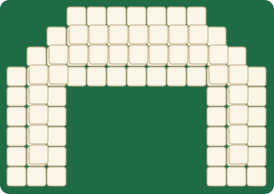
Hard · 98 tiles
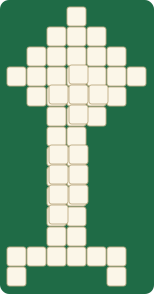
Medium · 56 tiles
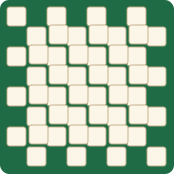
Medium · 50 tiles
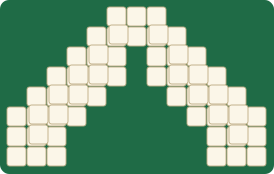
Medium · 68 tiles
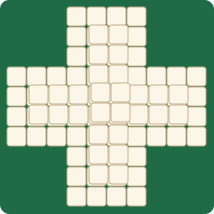
Hard · 96 tiles
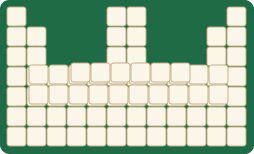
Hard · 90 tiles
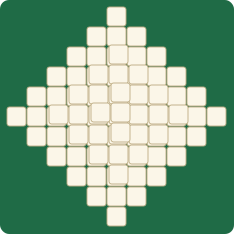
Hard · 90 tiles
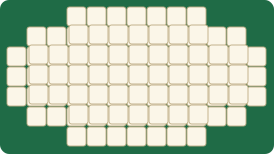
Medium · 122 tiles
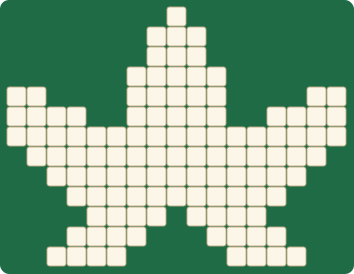
Expert · 114 tiles
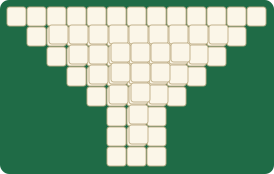
Hard · 88 tiles
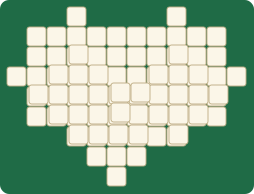
Hard · 98 tiles
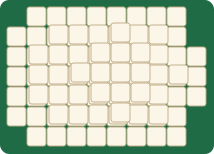
Hard · 110 tiles
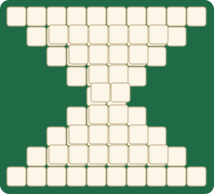
Hard · 84 tiles
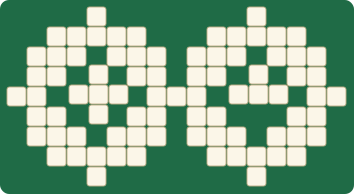
Hard · 80 tiles
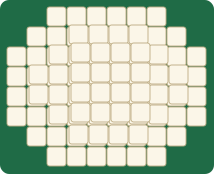
Hard · 120 tiles
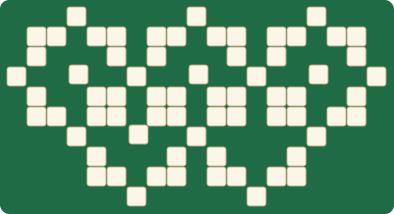
Hard · 68 tiles
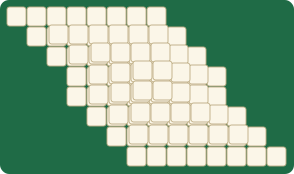
Hard · 120 tiles
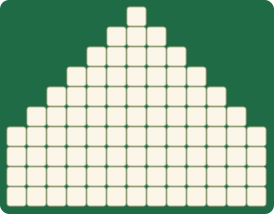
Hard · 88 tiles
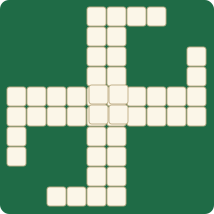
Medium · 48 tiles
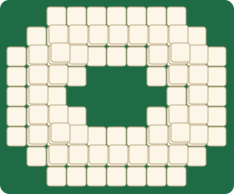
Hard · 116 tiles
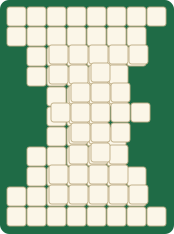
Expert · 104 tiles
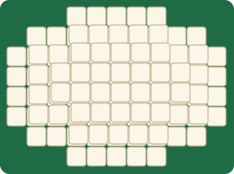
Medium · 142 tiles
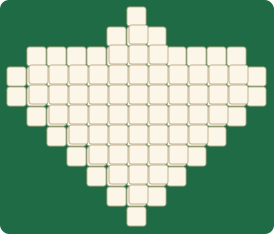
Hard · 128 tiles
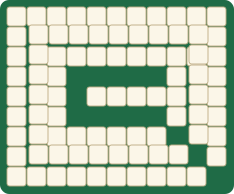
Expert · 86 tiles
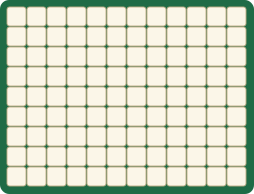
Medium · 108 tiles
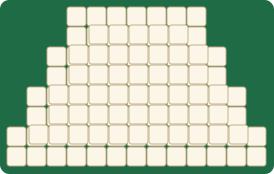
Medium · 128 tiles
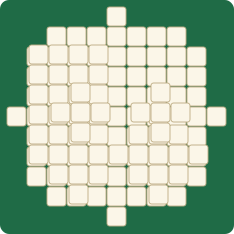
Expert · 132 tiles
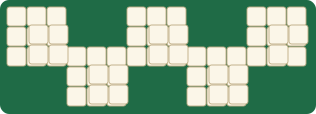
Medium · 64 tiles
Pyramid Mahjong Solitaire · Tower Mahjong · Twin Towers Mahjong · Bridge Mahjong · Cross Mahjong · Diamond Mahjong · Fortress Mahjong · Zodiac Mahjong · Animal Mahjong · Object Mahjong · Food Mahjong · Holiday Mahjong · Symbol Mahjong · Nature Mahjong · Easy Mahjong Solitaire · Hard Mahjong Solitaire · Christmas Mahjong · Ocean Mahjong
From the same team — more games, free to play online.