Easy Mahjong Solitaire
10 boards · free, no download.
10 boards · free, no download.
Play Easy Mahjong Solitaire free — instant in your browser, no download, no sign-up. Easy Mahjong Solitaire is where the game opens up and welcomes you in. Instead of the towering 144-tile turtle that most people picture, these boards are small and shallow, built from one or two thin layers that you can read at a glance. Almost every tile sits out in the open with a free left or right edge, so the matches you need are rarely buried or hidden. You spend your time recognizing pairs and clearing them, not untangling a knot. The result is a category that feels less like a puzzle to be defeated and more like a quiet, satisfying habit you can pick up for two minutes or twenty.
The appeal is simple and honest. There is no level-gating here, no streak to protect, and nothing to lose if you set your phone down mid-game. If you have never matched a single Mahjong tile, an easy board teaches you the one rule that matters in about thirty seconds. If you have played for years, these layouts are the equivalent of a comfortable chair: a guaranteed, low-stress win after a long day, a way to keep your eyes and memory loose, or just a pleasant minute of tile-tapping with a cup of tea. Every board in this collection is fully solvable from the start, and if you ever paint yourself into a corner, the Shuffle button re-deals the remaining tiles into a fresh, winnable arrangement so a single careless tap never ends the session.
Mahjong Solitaire is a tile-matching game played with the 144 pieces of a Mahjong set, but it shares almost nothing with the four-player Mahjong game played in living rooms across the world. There is no drawing, no discarding, and no opponents. The tiles are stacked into a fixed shape, and your only job is to remove them two at a time by matching identical pairs until the board is empty. A tile can be selected only when it is free, meaning nothing is stacked on top of it and at least one of its long sides, left or right, is open. That single rule governs everything.
What makes a board easy comes down to how the tiles are stacked, not how many there are. The classic difficulty in Mahjong comes from height. When tiles are piled four and five deep, the pieces you want are pinned underneath others, and you have to clear the right things in the right order to reach them. Easy boards remove that vertical pressure. They use one flat layer, or two at most, spread out across a generous footprint. With so little height, the number of free tiles available at any moment stays high, your choices rarely collapse to zero, and you can almost always see a path forward.
Some boards in this hub lean on a small footprint instead of shallow stacking. A compact diamond or a single long row may only hold a few dozen tiles, which keeps the whole game short and the bookkeeping light. Others, like a two-layer field, are physically larger but stay forgiving because the upper layer is thin and quickly stripped away. Both routes lead to the same place: a game you can win comfortably, without the long planning horizon that the big symmetrical dragons and fortresses demand.
The mechanic takes seconds to learn. Tap one free tile to select it, then tap a second free tile that shows the same face. The matched pair vanishes and whatever sat beneath or beside them may now become free. Most tiles pair with their exact twin, but two friendly exceptions make the game flow. Any flower tile matches any other flower, and any season tile matches any other season, so you never have to hunt for a precise duplicate among those eight special pieces. When the layout is empty, you have won.
Even though these boards are forgiving, a little technique turns a likely win into a certain one. The core idea is to always protect your options. Tiles come in groups of four identical faces, which means each face can be cleared as two separate pairs. The danger, even on an easy board, is matching two copies of a face while the other two are stuck where you cannot reach them, leaving an orphaned pair you can never complete. So before you remove a pair, glance at where its other two siblings are sitting. If both remaining copies are still locked, it is often wiser to clear a different, safer pair first and come back once the locked tiles have opened up.
Beyond that, work from the edges and the top. On a two-layer board, peel the upper tiles early, because they are what is trapping the lower ones, and a tile freed underneath is far more useful than one you already had access to. On a long, flat strip such as Long Row or Garden Path, the ends are your engine: clearing from the outside in keeps a steady supply of fresh free tiles arriving rather than emptying the middle and stranding the rest. And there is no penalty for thinking. Take your time, scan the whole shape, and if you genuinely run dry, Shuffle reshuffles the remaining tiles into a guaranteed-solvable layout, so the game stays winnable to the very last pair.
The Easy hub gathers a whole family of small and shallow shapes, each with its own character. Garden Path winds across the screen like a meandering walkway, a long, mostly single-layer trail that rewards steady clearing from either end. Pond is a soft, rounded pool of tiles, open in the middle and easy to drain. Stepping Stones scatters little clusters with plenty of gaps between them, so free edges are everywhere and you hop from one match to the next. Saucer is exactly what it sounds like, a wide shallow dish that holds its tiles loosely and lets almost all of them stay reachable.
The geometric shapes give the category its variety. Plus Sign builds a clean cross with four open arms, each arm feeding free tiles toward the center. Small Diamond is a compact gem, quick to finish and a perfect first board for a newcomer. Long Row strips the game down to its essence, a straight line of pairs where strategy is at its simplest and a win is never far off. L Shape bends a flat field around a corner, a touch more interesting to read than a straight line but still wide open. Frame outlines a hollow rectangle, a border of tiles around an empty middle, which keeps every piece near an edge and within easy reach.
Then there is Two Layer, the gentle gateway to the bigger game. It looks more substantial than the others because it genuinely stacks tiles, but only two deep, so it teaches the rhythm of clearing a top layer to expose the one below without ever becoming overwhelming. Taken together, this range means easy never has to mean repetitive. You can chain a handful of these in a single sitting and feel like you visited ten different little worlds, from a quiet pond to a tidy picture frame, all sharing the same relaxed, beatable spirit.
Part of the quiet pleasure of Mahjong Solitaire is the tiles themselves. The set is a small museum of Chinese symbolism: three suited series in Circles, Bamboo, and Characters that climb from one to nine, the honor tiles of the four winds and the red, green, and white dragons, and the decorative flowers and seasons that have brightened Mahjong sets for centuries. On a shallow easy board you actually get to look at them. There is no frantic scramble, so you start to recognize the curl of a bamboo stalk or the look of the white dragon by sight, which is exactly how seasoned players read a tile in an instant.
The shapes carry their own charm because they are evocative rather than abstract. A pond, a garden path, stepping stones across a stream, a saucer on a table, a picture frame on a wall, these are restful, domestic images, and that is no accident in a category built for relaxation. They are deliberately legible too. Where a master-level board hides its structure in symmetry and depth, an easy shape announces itself. You can see at the first glance that a Plus Sign is a cross and a Diamond is a diamond, and that visual honesty is a big part of why the boards feel calm rather than daunting.
There is a small history lesson tucked in here as well. The tile-on-tile solitaire most people know was popularized by a computer version in the early 1980s, and its signature board was a tall pyramid. Easy layouts are, in a sense, a return to first principles: strip away the intimidating architecture and you are left with the pure, ancient pleasure of finding two matching faces. These shapes are the friendly front door to a game that can get marvelously deep, and they are genuinely fun on their own terms, not merely a tutorial you have to endure before the real thing begins.
Make no mistake about the difficulty: these are the most forgiving boards on the site, and that is the whole point. With one or two layers and so many free tiles, the odds of a board playing itself smoothly to the finish are very high, and the Shuffle safety net means even an unlucky tap is recoverable. A clear on an easy layout might take you a couple of minutes, not the long campaign that a 144-tile fortress requires. If you measure a session in cups of coffee, most of these are a single short sip.
That makes the category ideal for a few kinds of player. It is built for the absolute beginner who wants to learn the one rule of Mahjong without staring at a wall of tiles, and it is just as well suited to relaxed and older players who want a clear, unhurried, low-stakes game that respects their time and their eyes. It is also the right choice for anyone short on minutes: a quick, dependable win between tasks, on a commute, or in a waiting room, with no obligation to ever come back. There is no pressure to improve, no leaderboard breathing down your neck, just a pleasant loop of recognize, match, repeat.
If you find these clearing a little too easily and you start to want more of a fight, that is a healthy sign, and the site has plenty of taller, denser boards waiting whenever you choose to climb. But many people stay right here by preference, and they are entirely right to. Easy Mahjong Solitaire is not a lesser version of the game. It is the game at its most generous, the place you return to when you want the satisfaction of a completed board without the strain, and a reliably good way to spend a handful of calm minutes.
Difficulty in Mahjong comes mostly from height, not tile count. Easy boards use only one or two thin layers spread over a wide area, so very few tiles are buried. At almost any moment you have a large number of free, selectable tiles to choose from, which keeps a winning path visible and removes the long, careful planning that deep multi-layer boards demand. A small footprint also helps, since fewer tiles means a shorter, lighter game.
Yes. Every board in the Easy hub is generated to be fully solvable from the opening deal, so there is always a sequence of matches that clears it completely. If you do get stuck because the right pairs are blocked, the Shuffle button re-deals the remaining tiles into a new arrangement that is also guaranteed solvable. You can never reach a true dead end that ends the game against you.
The eight bonus tiles are the one place where you do not need an exact twin. Any flower tile matches any other flower tile, and any season tile matches any other season tile. So if two flowers are free, you can pair them even though their pictures differ, and the same goes for seasons. Every other tile in the set still matches only its identical face. This rule speeds the game up and is especially handy on small boards.
Start with the very smallest shapes here, such as Small Diamond, Long Row, or Plus Sign. They hold the fewest tiles and lay nearly all of them out in plain view, so you can focus on the single rule of matching two free, identical tiles without anything getting in the way. Once that rhythm feels natural, try Two Layer to learn how clearing a top tile frees the one beneath it, which is the core skill behind every larger board.
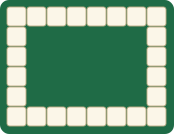
Easy · 24 tiles
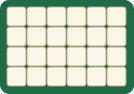
Easy · 24 tiles
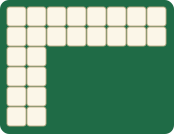
Easy · 24 tiles

Easy · 24 tiles
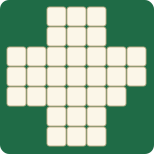
Easy · 32 tiles
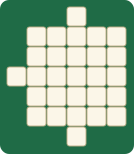
Easy · 28 tiles
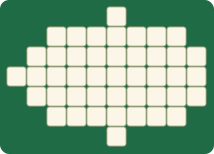
Easy · 44 tiles

Easy · 24 tiles

Easy · 26 tiles
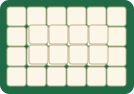
Easy · 32 tiles
Pyramid Mahjong Solitaire · Tower Mahjong · Twin Towers Mahjong · Bridge Mahjong · Cross Mahjong · Diamond Mahjong · Fortress Mahjong · Zodiac Mahjong · Animal Mahjong · Object Mahjong · Food Mahjong · Holiday Mahjong · Symbol Mahjong · Nature Mahjong · Geometric Mahjong · Hard Mahjong Solitaire · Christmas Mahjong · Ocean Mahjong
From the same team — more games, free to play online.